
Science Systems
Schmidt Sciences commits up to $20M to eight standout researchers named 2026 Polymaths
Sep 22, 2026
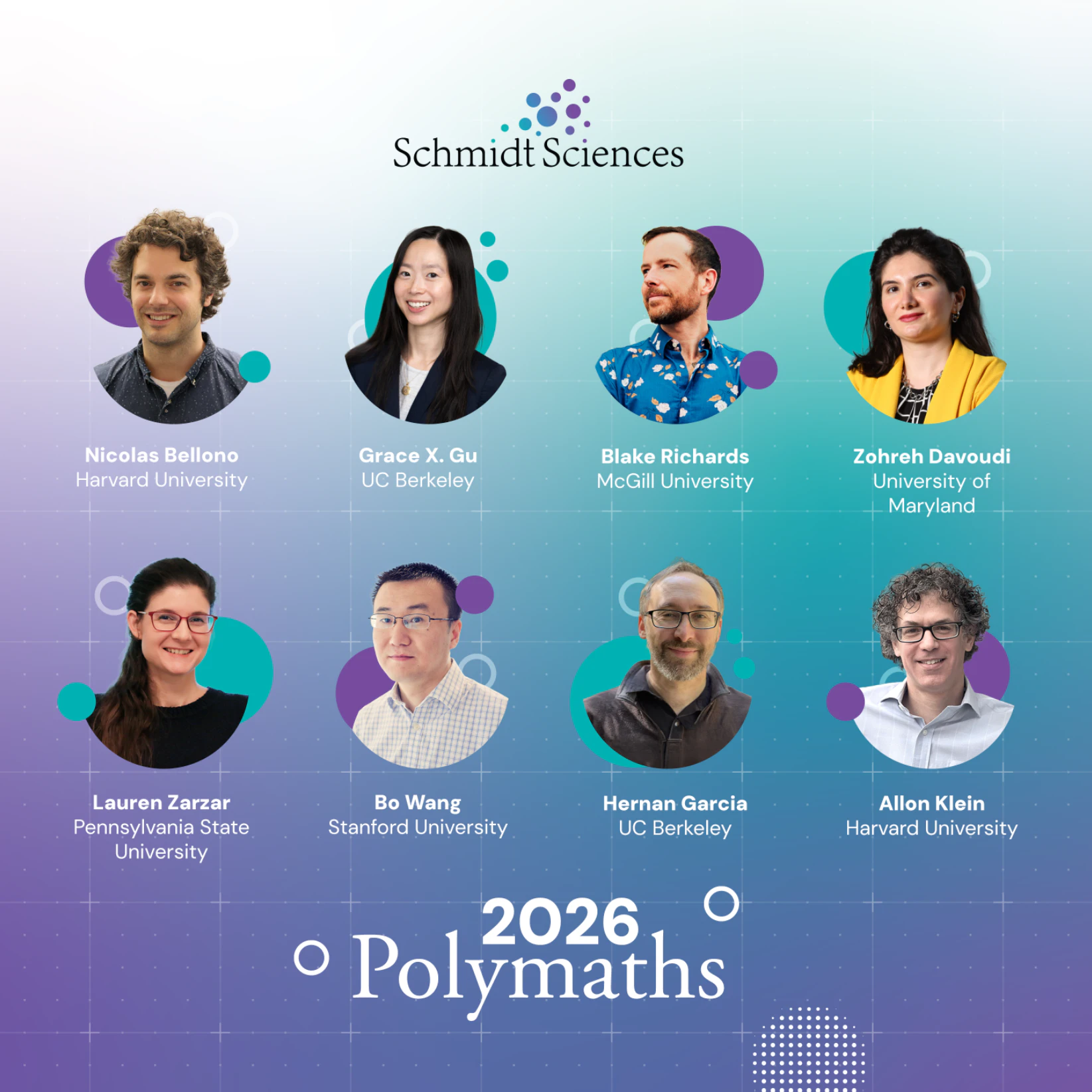
Leading scientists making ambitious leaps beyond their established areas of research will each receive up to $2.5 million to pursue bold new lines of inquiry.
Contact: Carlie Wiener, [email protected]
NEW YORK— Schmidt Sciences announced today the eight 2026 Schmidt Polymaths who will receive a combined total of up to $20 million to take their research in ambitious new directions. The award recognizes proven records of bold scientific achievement and willingness to tackle complex questions beyond their established areas of expertise. This year’s Polymaths will explore how the immune systems of invertebrates could reveal new therapies for humans, how food crops could become more resilient as the climate changes and how AI models trained on human behavior could deepen our understanding of the mind.
“Each of these researchers has already shown real range and originality in their work. Now they’re ready to bring that to an entirely new set of questions,” said James Ricci, director at Schmidt Sciences. “The award gives them the freedom and runway to make that leap and see where it leads.”
This marks the sixth cohort of Schmidt Polymaths. Earlier cohorts have used the award to create rechargeable molecular computers powered by heat, reveal how hidden feather layers make songbirds more colorful, read what whole communities eat from the food DNA in wastewater, discover new mathematical formulas with the help of AI, and more.
This year’s cohort joins a community of 35 Schmidt Polymaths, drawn from 31 universities globally. The 2026 cohort includes first-time Polymaths awardees from the University of Maryland, Pennsylvania State University and McGill University. Each Polymath will receive up to $2.5 million over five years in flexible funding, giving them the freedom to experiment with methods and approaches that conventional grants may not support. To qualify, researchers must have reached tenure, or an equivalent milestone, within the prior three years, alongside a track record that already spans more than one area of expertise. Nominated by universities worldwide, applicants are evaluated on both past accomplishments and future ambitions.
Allon Klein, professor of systems biology
Harvard Medical School
Dr. Klein will map the immune systems of invertebrates at single-cell resolution, searching for defense strategies that evolved entirely outside the vertebrate lineage.
Blake Richards, associate professor, School of Computer Science and Department of Neurology and Neurosurgery
McGill University
Dr. Richards plans to gather rich data on human behavior to train AI foundation models for neuroscience, working toward a deeper understanding of the diversity and individuality of human cognition that moves beyond psychiatry’s limited, coarse diagnostic categories.
Bo Wang, associate professor of bioengineering
Stanford University
Dr. Wang will explore why warm-bloodedness evolved separately in birds and mammals and how the systems that regulate body temperature shaped the nervous system, metabolism and immune function.
Grace X. Gu, associate professor of mechanical engineering
University of California, Berkeley
Dr. Gu will study how the structure and processing of food influence taste, texture and nutrition, pairing food science with AI and manufacturing to design personalized, functional edible products.
Hernan Garcia, associate professor of molecular & cell biology and physics
University of California, Berkeley
Dr. Garcia will adapt rapid gene-editing and screening methods for use in plants to develop more climate-resilient crops.
Lauren Zarzar, professor of chemistry
Pennsylvania State University
Dr. Zarzar will study how reactions in tiny spaces, such as the thin films inside a foam or the fluid compartments that cells form, can open new ways to make molecules and materials.
Nicholas Bellono, professor of molecular and cellular biology
Harvard University
Dr. Bellono will study how organisms living in close partnership sense and respond to one another, identifying the receptors and signals they use to communicate.
Zohreh Davoudi, associate professor of physics
University of Maryland
Dr. Davoudi will apply quantum sensing and simulation tools to study how the early universe evolved, aiming to detect new particles and their interactions and to deepen our understanding of cosmology.
Images, and b-roll footage available here.
About Schmidt Sciences
Schmidt Sciences is a nonprofit organization founded in 2024 by Eric and Wendy Schmidt that works to accelerate scientific knowledge and breakthroughs with the most promising, advanced tools to support a thriving planet. The organization prioritizes research in areas poised for impact including AI and advanced computing, biosciences, climate, and astrophysics and space—as well as strengthening the people, tools, and practices that science depends on through its science systems program.
Press Kit
Download the full press release and explore related digital assets below.
More Blog Posts
-
AI & Advanced Computing
Elias Stengel-Eskin (University of Texas at Austin), Simon Kirby (University of Edinburgh), Hale Sirin (Schmidt Sciences) | Sep 14, 2026
AI agents evolve their own languages
-
Climate
Aug 9, 2026
Schmidt Sciences grants $26 million to researchers translating climate models to climate action