
AI & Advanced Computing
Schmidt Sciences Names 28 AI2050 Fellows Tackling the Defining AI Challenges of Our Time
Oct 1, 2026
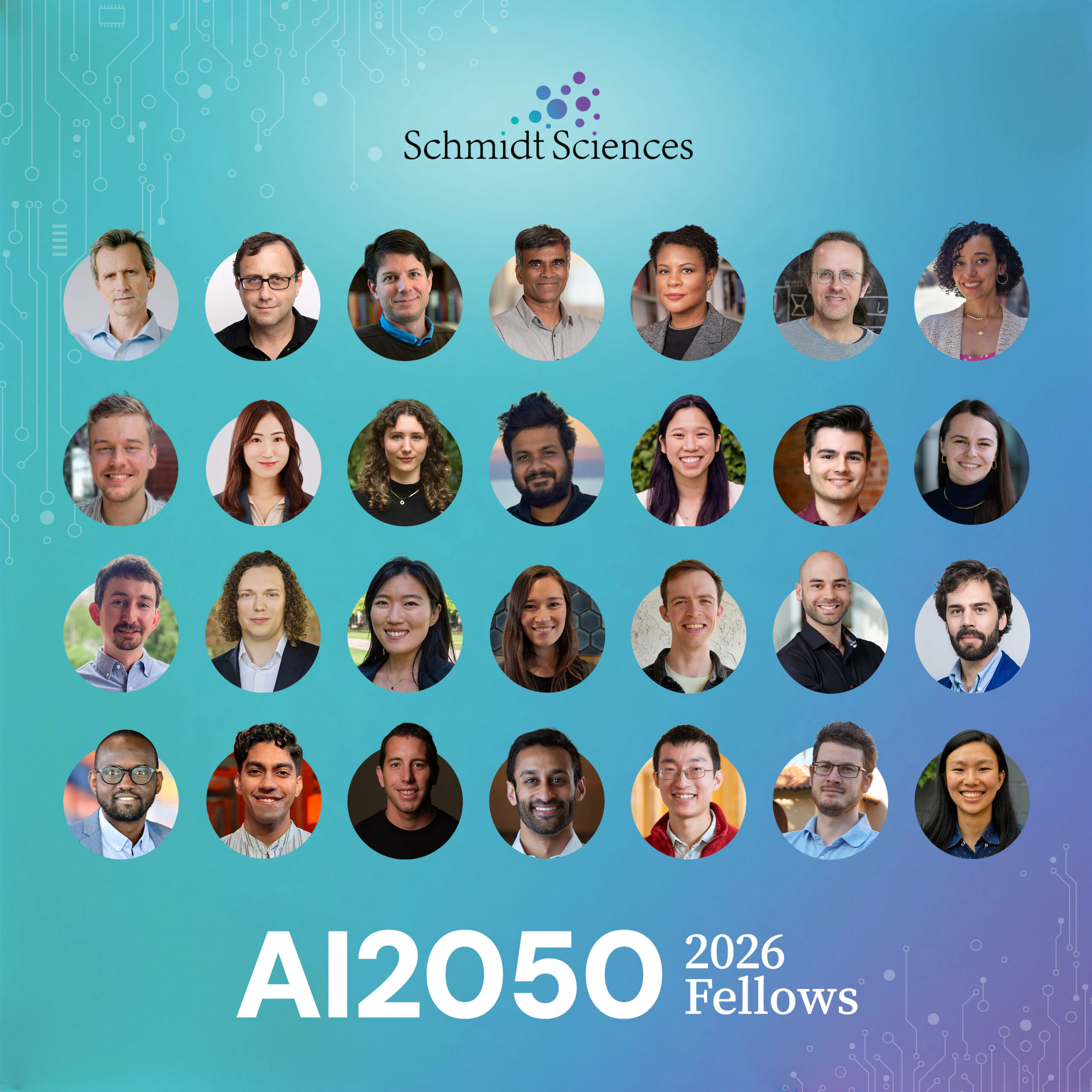
Supported by up to $16 million over three years, the fifth cohort of 28 AI2050 Fellows will address the most important long-term problems in AI which need to be solved for AI to be truly beneficial to society by 2050.
Contact: Carlie Wiener – [email protected]
NEW YORK – Schmidt Sciences announced today the fifth cohort of AI2050 fellows–28 researchers from around the world who will receive up to $16 million to help ensure artificial intelligence develops responsibly to expand human knowledge, address global science problems and benefit society.
The cohort includes 22 early-career fellows and six senior fellows who will be supported by up to $16 million over three years to pursue their research. This brings the AI2050 community to 127 fellows representing 50 institutions across 11 countries, with up to $80 million in funding committed to date.
The awardees will benchmark the capabilities and risks of self-improving AI systems, use AI to model and predict unprecedented extreme weather events that have never been recorded but remain physically possible, and design AI systems to guide experiments aimed at engineering immune cells to fight cancer and autoimmune diseases, among many other projects.
Launched in 2022, the AI2050 program is motivated by the question: “It’s 2050. AI has turned out to be hugely beneficial to society. What happened? What are the most important problems we solved and the opportunities and possibilities we realized to ensure this outcome? “
AI2050 grantees focus their research on a working list of Hard Problems in AI, from making sure the technology doesn’t endanger humans to finding ways it can address global issues. Conceived and co-chaired by Eric Schmidt and James Manyika, SVP of Research, Labs, Technology & Society at Google, the program advances Eric and Wendy Schmidt’s commitment to supporting talented researchers tackling consequential scientific and societal challenges.
“AI will shape nearly every aspect of our future, but the direction it takes is not inevitable,” said Eric Schmidt, co-founder of Schmidt Sciences and co-chair of AI2050. “It will be determined by researchers willing to ask difficult questions, test bold ideas and confront risks before they become crises. These fellows are doing the foundational work needed to ensure AI safely becomes a force for scientific discovery and human progress, creating benefits that can reach people everywhere and improve lives around the world.”
Beyond financial support, AI2050 fellows attend an annual gathering to share findings, learn from experts and build connections across disciplines. They may also gain access to additional funding to collaborate with other fellows on AI2050-related projects, as well as funding for substantial compute needs.
“In order to realize the beneficial aspects of AI and to avoid and mitigate its risks, the most important questions to get right about AI cannot be answered by computer science alone,” said James Manyika, co-chair of AI2050 and a senior vice president at Google and Alphabet. “They require insights from across disciplines and context, from the sciences to humanities. This cohort brings together researchers with the range of expertise and perspectives needed to understand AI’s real-world consequences and help translate its capabilities into broadly shared progress.”
Over its first four years, AI2050 has supported fellows who developed AI tools to help power grids safely handle the changing supply of wind and solar power, built an AI system to design novel molecules that chemists can make in the lab, and demonstrated how AI-powered computer worms could autonomously adapt their attacks to each new target, giving cybersecurity defenders an early warning.
The 2026 AI2050 Senior Fellows are:
Francis Bach, research director
Inria, France’s National Institute for Research in Digital Science and Technology
Dr. Bach will develop an external auditing system that checks whether AI agents’ actions follow safety rules and identifies when they can be trusted to act reliably.
Mikhail Belkin, professor
University of California San Diego
Dr. Belkin will investigate the hidden internal mechanisms that drive complex AI behavior, helping researchers better understand, monitor and steer advanced systems.
David Danks, professor
University of Virginia
Dr. Danks will study how human values and AI systems change one another over time and translate those findings into practical guidance for AI design, development and governance.
Sendhil Mullainathan, professor
Massachusetts Institute of Technology
Dr. Mullainathan will develop tools that translate patterns detected by AI into clear, testable scientific theories, helping researchers turn opaque predictions into discoveries across medicine, chemistry and education.
Alondra Nelson, professor
Institute for Advanced Study
Dr. Nelson will follow three American families across three regions and three generations to document how overlapping AI systems shape everyday life, laying the groundwork for understanding and navigating AI’s growing influence.
Bernhard Schölkopf, scientific director
ELLIS Institute Tübingen and Max Planck Institute for Intelligent Systems
Dr. Schölkopf will develop models that enable AI systems to learn by observing, acting and experimenting, with the goal of helping them reason about interventions, generalize more robustly and support scientific discovery.
The 2026 AI2050 Early Career Fellows are:
- Sahar Abdelnabi, principal investigator & independent group leader, ELLIS Institute Tübingen & Max Planck Institute for Intelligent Systems
- Maksym Andriushchenko, principal investigator & independent group leader, ELLIS Institute Tübingen & Max Planck Institute for Intelligent Systems
- Akari Asai, assistant professor, Carnegie Mellon University
- Andrea Bajcsy, assistant professor, Carnegie Mellon University
- Ashesh Chattopadhyay, assistant professor, University of California, Santa Cruz
- Irene Chen, assistant professor, University of California at Berkeley
- Alex Damian, assistant professor, Massachusetts Institute of Technology
- Bailey Flanigan, assistant professor, Massachusetts Institute of Technology
- Daniel Fried, assistant professor, Carnegie Mellon University
- Peter Henderson, assistant professor, Princeton University
- Yunha Hwang, assistant professor, Massachusetts Institute of Technology
- Allison Koenecke, assistant professor, Cornell University
- Nathan Lambert, executive director, Trillium Labs
- Romain Lopez, assistant professor, New York University
- Chris Maddison, assistant professor, University of Toronto
- Shamsuddeen Hassan Muhammad, senior lecturer, Bayero University, Kano
- Aditya Nair, assistant professor, Nanyang Technological University
- Juan Carlos Perdomo, assistant professor, New York University
- Manish Raghavan, assistant professor, Massachusetts Institute of Technology
- Alexander Tong, principal investigator, Aithrya
- Florian Tramèr, assistant professor, ETH Zurich
- Angelina Wang, assistant professor, Cornell Tech
About Schmidt Sciences
Schmidt Sciences is a nonprofit organization founded in 2024 by Eric and Wendy Schmidt that works to accelerate scientific knowledge and breakthroughs with the most promising, advanced tools to support a thriving planet. The organization prioritizes research in areas poised for impact including AI and advanced computing, astrophysics, biosciences, climate, and space—as well as supporting researchers in a variety of disciplines through its science systems program.
About AI2050
AI2050 is an initiative of Schmidt Sciences, conceived and co-chaired by Eric Schmidt and James Manyika, that supports exceptional people working on key opportunities and hard problems that are critical to ensuring society benefits from AI. To learn more, visit ai2050.schmidtsciences.org.
More Blog Posts
-
Science Systems
Sep 22, 2026
Schmidt Sciences commits up to $20M to eight standout researchers named 2026 Polymaths
-
AI & Advanced Computing
Elias Stengel-Eskin (University of Texas at Austin), Simon Kirby (University of Edinburgh), Hale Sirin (Schmidt Sciences) | Sep 14, 2026
AI agents evolve their own languages