Astrophysics & Space
Exploding Stars, Missing Galaxies and Distant Worlds: Inaugural FirstLight Awards Cutting-Edge Science with Access to New Schmidt Observatory System
Nov 3, 2026
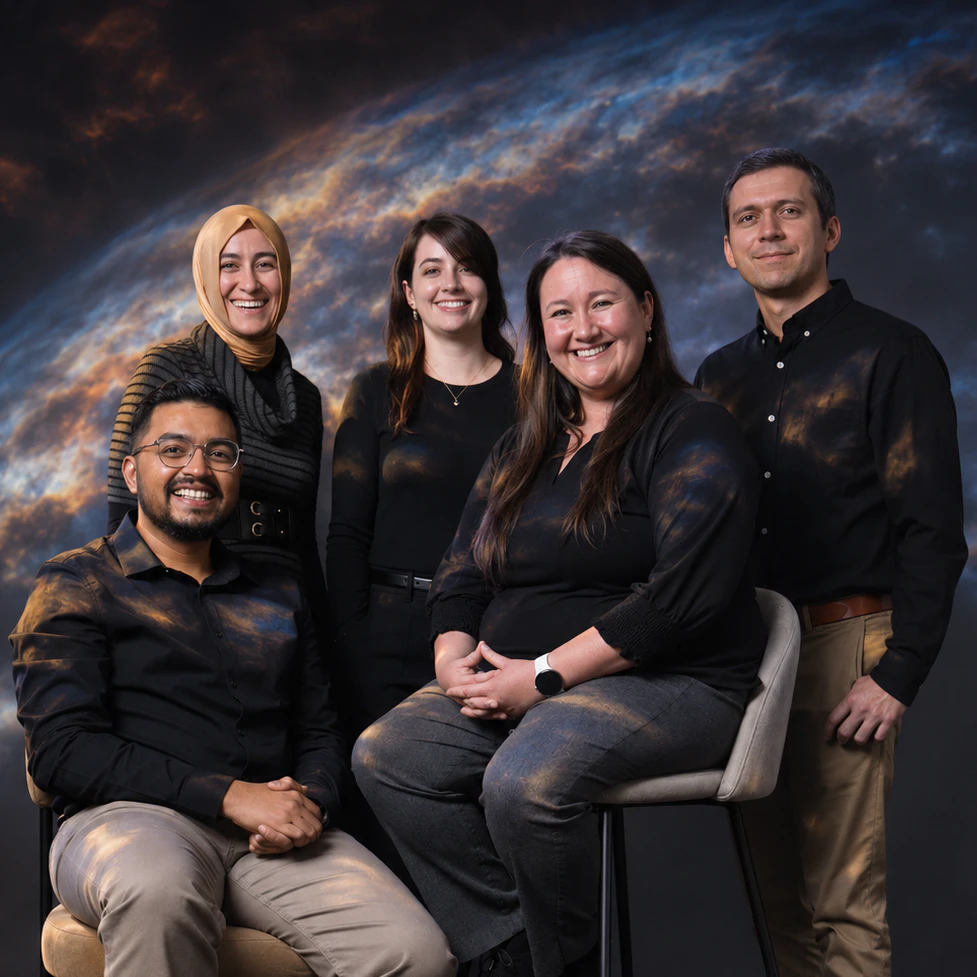
Five early-career researchers to receive up to $12.5 million to lead open, collaborative astrophysics research that will explore the universe
Contact: Carlie Wiener – [email protected]
FLORENCE, ITALY—Five early-career scientists will receive a total of up to $12.5 million as the first winners of Schmidt Sciences’ new FirstLight Awards, which honor researchers pursuing groundbreaking discoveries centered on major astronomical research observatories, including the Eric and Wendy Schmidt Observatory System, Schmidt Sciences announced today.
Each awardee will receive as much as $500,000 annually for up to five years to build and lead a team that will seek to advance our understanding of the universe. As part of the award, scientists will make their research, software and related work using the Schmidt Observatory System freely and publicly accessible. Postdoctoral researchers and students recruited into the awardees’ research groups will be named FirstLight Fellows, extending the program’s investment to the next generation of scientists.
“Much like the first images from a telescope, early-career scientists bring new ideas and new ways of seeing to their disciplines,” said Wendy Schmidt, co-founder of Schmidt Sciences. “The FirstLight Awards honor the unique insights that come from fresh perspectives, global collaborations and the new capabilities brought by emerging technology and the Schmidt Observatory System. We’re eager to see what new possibilities the awardees create, for their teams and for astronomers around the world.”
Researchers in the first cohort will hunt for the faintest dwarf galaxies and the most exotic compact binary systems in the Universe, study supernovae in the first hours after they explode, monitor how space weather shapes the atmospheres of planets around other stars, and explore how giant planets and brown dwarfs form.
The FirstLight Awards aim to build a network of scientists who will integrate rapidly evolving technologies including AI, large-scale data systems and open access into astrophysics while fostering broad participation in shaping the scientific future of the Schmidt Observatory System. Selected from a pool of more than 100 applicants, the cohort was chosen by three rounds of review by external expert committees.
The Schmidt Observatory System, comprising Argus, Lazuli, LFAST, and DSA, will study everything from nearby exoplanets and exploding stars to distant galaxies and the large-scale structure of the universe, using complementary capabilities across optical, infrared, and radio wavelengths.
“Building four new observatories is an extraordinary scientific undertaking, but its ultimate value lies in the discoveries that researchers make with it,” said Arpita Roy, Director of the Astrophysics & Space Center at Schmidt Sciences. “With FirstLight, we are investing early in the people who will turn these new capabilities into important science. We have selected researchers with the scientific imagination to ask ambitious questions, the technical depth to pursue them, and the commitment to develop tools and knowledge that others can build upon. I am excited to see what our inaugural cohort of FirstLight scientists will discover.”
FirstLight awardees will also develop shared research tools and lead workshops, training and public communication. Annual gatherings will bring the teams together to exchange methods and develop collaborations across research areas.
The inaugural FirstLight awardees are:
Adina Feinstein, Michigan State University
“The TEMPO Survey: Towards a Unified Theory of how Space Weather Sculpts the Exoplanet Population” will track flares and outbursts from young stars and gas escaping from the planets they host, revealing how “space weather” shapes the planetary systems we see today.
Burçin Mutlu-Pakdil, Dartmouth
Co-PIs: David Sand (University of Arizona), Kristine Spekkens (Queen’s University at Kingston)
“A Paradigm Shift in Near-Field Cosmology with the Schmidt End-to-End Dwarf Discovery (SEEDD) Pipeline” will search for the smallest, faintest and most numerous galaxies in the Universe, testing our understanding of dark matter and how galaxies form.
Griffin Hosseinzadeh, UC San Diego
“The Lazuli-Argus Program for Infant Supernovae” will discover and characterize supernovae in their first hours, exploring the composition of dying stars and the material they shed before exploding.
Kimberly Ward-Duong, Smith College
Co-PIs: Katherine Follette (Amherst College), Yifan Zhou (University of Virginia)
“Illuminating the Mechanisms of Giant Planet Formation with all Four Schmidt Observatories in Concert” will monitor how young giant planets and brown dwarfs grow while hunting for new planets still embedded in their birth environments, discovering how these systems form and evolve.
Vivek Venkatraman Krishnan, Max Planck Institute for Radio Astronomy
Co-PIs: Ewan Barr (Max Planck Institute for Radio Astronomy), Paulo Freire (Max Planck Institute for Radio Astronomy)
“RAPID: Rapid Accelerated Pulsar Identification with the DSA Chronoscope” will apply advanced computational techniques to hunt for pulsars orbiting companions, including neutron stars, white dwarfs, or even black holes, testing general relativity within environments that are otherwise challenging to find.
About Schmidt Sciences
Schmidt Sciences is a nonprofit organization founded in 2024 by Eric and Wendy Schmidt that works to accelerate scientific knowledge and breakthroughs with the most promising, advanced tools to support a thriving planet. The organization prioritizes research in areas poised for impact including AI and advanced computing, astrophysics, biosciences, climate, and space—as well as supporting researchers in a variety of disciplines through its science systems program.
Press Kit
Download the full press release and explore related digital assets below.