
Nigel Reuel
| Program | Innovation for Bioreactors |
| Organization | Iowa State University |
| Field of Study | Biosciences |
Using digital twin technology, BioMADE grantee Nigel Reuel is training an intelligent bioreactor to autonomously troubleshoot and solve problems, clearing the way for reliable, consistent manufacturing at scale.
“Biology is an interesting thing to try to control,” says Nigel Reuel, an associate professor of chemical engineering at Iowa State University. “It’s fundamentally uncontrollable.”
And yet, Schmidt Sciences’ support for BioMADE worked to do exactly that. Reuel, along with partners at Novozymes, was one of several grantees of the initiative working to make bioreactors—which take biological materials and transform them into useful end products—more efficient, cost-effective and scalable.
Reuel’s project sought to optimize and control what happens inside a bioreactor using machine learning and continuous monitoring via sensors.
“Can we have a bioreactor intelligently adapt what it’s doing, to maximize productivity?” Reuel asks.
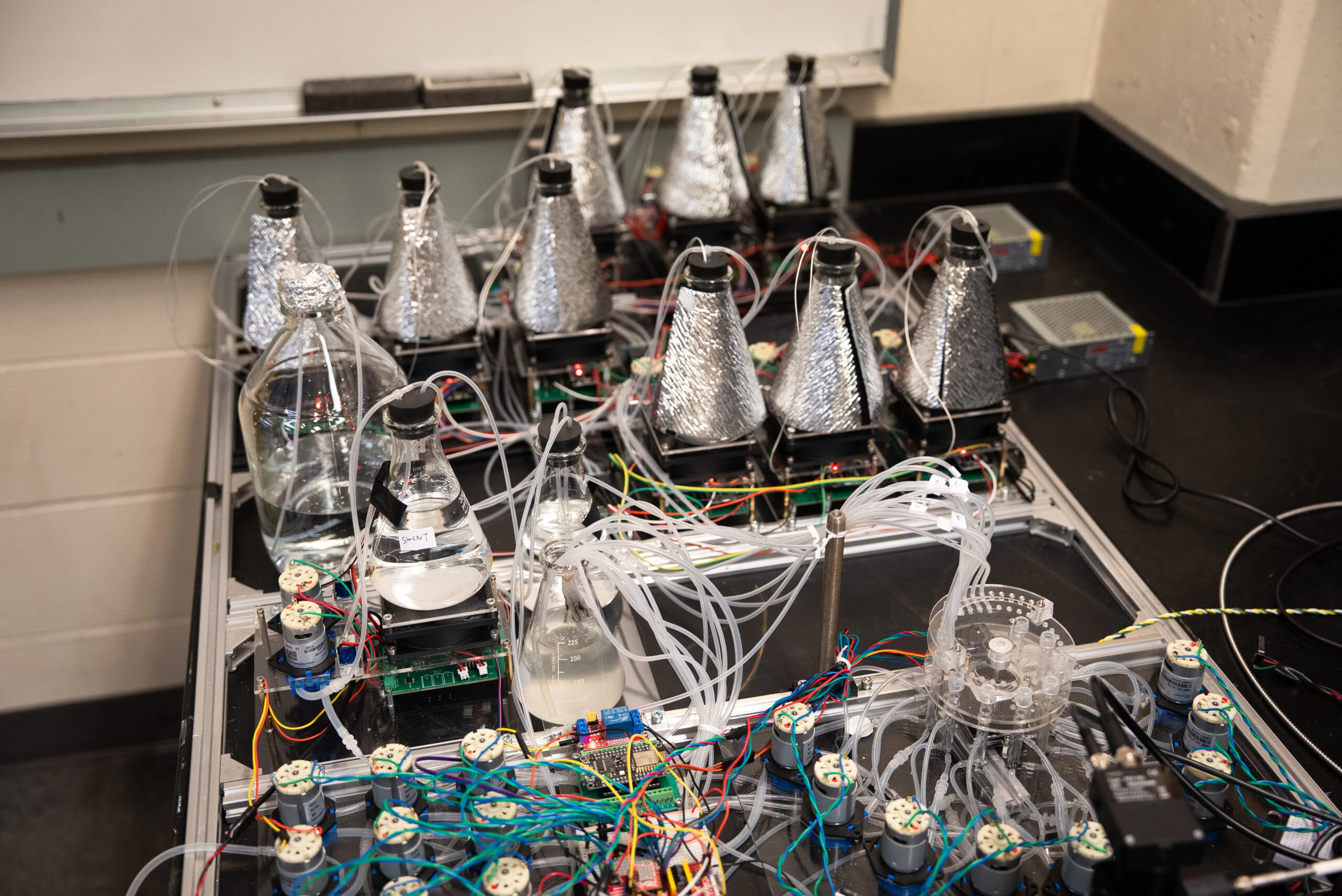
Step one for Reuel and Mei-Tsan (Jimmy) Kuo, a chemical engineering graduate student he recruited for the effort, was to build an array of nine sensor-equipped bioreactors to start generating data. Buying them would not only have been cost prohibitive, but also less controlled.
“We had to make them ourselves so we could control the temperature, the spin, how they’re fed, and take that data to feed to the model,” Reuel says.
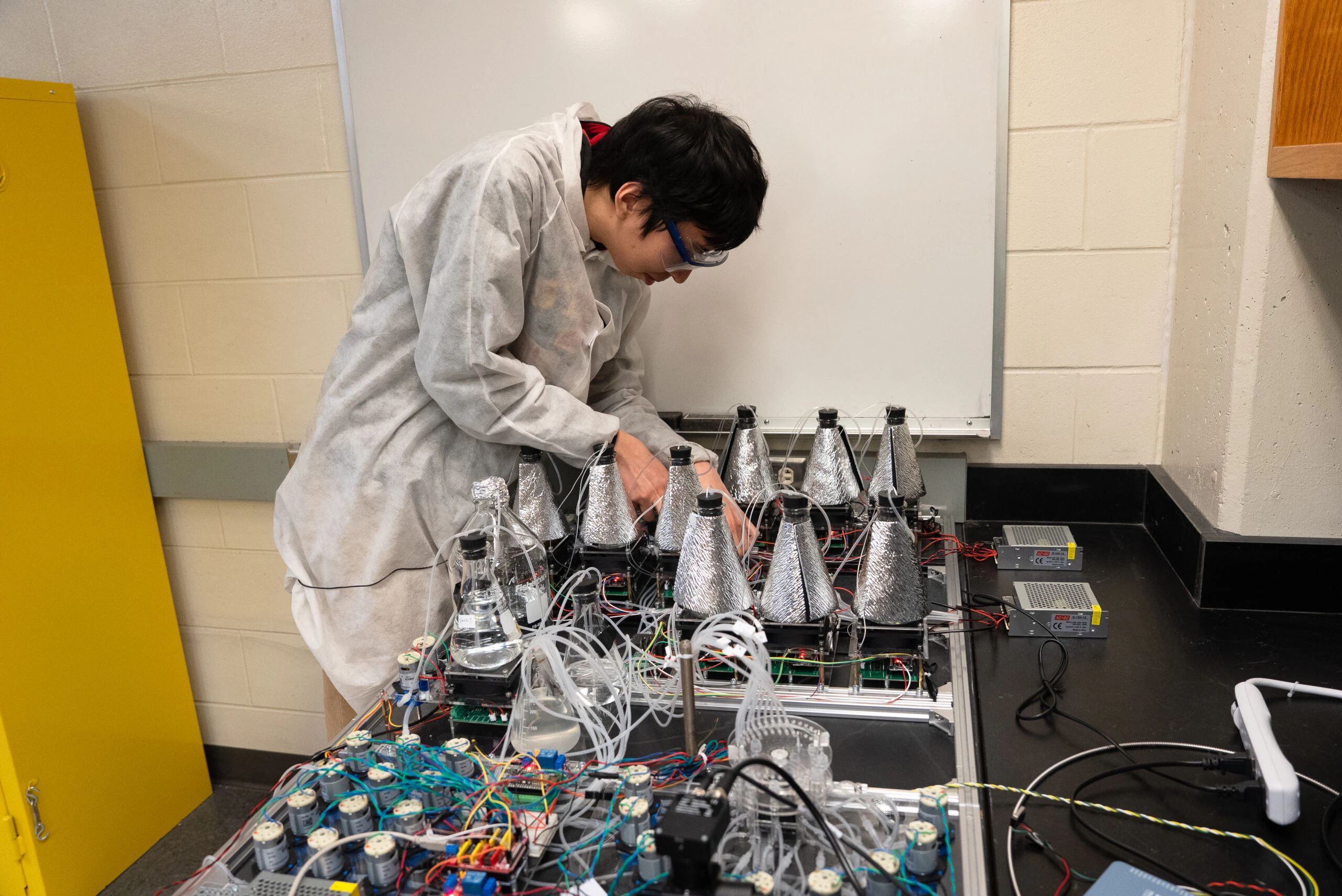
Reuel, who passed time building his own custom rocket engines and measuring their thrust as a kid, enjoyed getting into the weeds of biomanufacturing measurement and optimization.
“Unlike a synthetic system, a biological system won’t behave the same every time,” Reuel says. “If a cell gets compromised, it will have totally different growth characteristics. As a scientist, that’s interesting.”
Once the array worked—running a process with continuous monitoring and successful results—Reuel worked with computer science graduate student Sai Harish Uthravalli to create a digital twin of the bioreactor system to train a machine learning model. Then Reuel challenged the computer model or twin with changing conditions: a failed heat pump, a break in feedstock flow, a change in temperature, to test how the computer would instruct the digital twin to respond.
“We had some interesting findings here—for example it took a couple thousand iterations for the computer to learn the system,” Reuel says. “Then you show it something new, and it still responds pretty well. If it works, it’s an intelligent system that you don’t need to have a human monitoring it.”
The team is now working to put together the physical and the digital, so that the computer can make decisions to keep a bioreactor humming along, and publish the results. They also turned the arrays into a kit that costs less than $300, making it possible for even high school classrooms to buy a set to study reactions.
“You can’t learn how something works until you break it,” Reuel says. “And at $300 a piece, you can break these.”
Beyond the kits, in the manufacturing world, the possibilities are vast.
“Let’s say you’ve found a way to break down plastic using a particular enzyme,” Reuel says. “You use our system to test, perfect and learn how to scale your process. Then you put all of that into a large bioreactor, and our same computer model keeps it going.”
He continues, “Then it goes to market and frees up the humans to try other creative things.”