
Jack Atkinson
| Program | Virtual Institute for Scientific Software (VISS) |
| Organization | University of Cambridge |
| Field of Study | Computer Science |
By partnering software engineers with climate researchers to collaboratively build and train models, Dr. Jack Atkinson is working to create better tools and establish a community of increasingly tech-savvy scientists.
Climate models shape how governments set emissions targets, but most climate scientists receive little training in writing the computer code and software that makes those models run. An expert in atmospheric physics or ocean circulation, for instance, may understand exactly what a model should do, yet still struggle to build software that does it well. Jack Atkinson and his team at the University of Cambridge’s Institute of Computing for Climate Science (ICCS) are working to close that gap.
“So much science involves computing and software in some way, from sophisticated modeling to processing and analyzing data,” Atkinson says. “But scientists often don’t receive much formal education in these fields.”
ICCS, which is a part of Schmidt Sciences’ Virtual Institute for Scientific Software, employs a dozen software engineers who work with researchers from the Virtual Earth System Research Institute (VESRI), another Schmidt Sciences program––and major climate modeling initiative. Their expertise spans machine learning, numerical modeling, high-performance computing and various scientific domains. Atkinson himself worked on geoscience modeling before moving into research software.
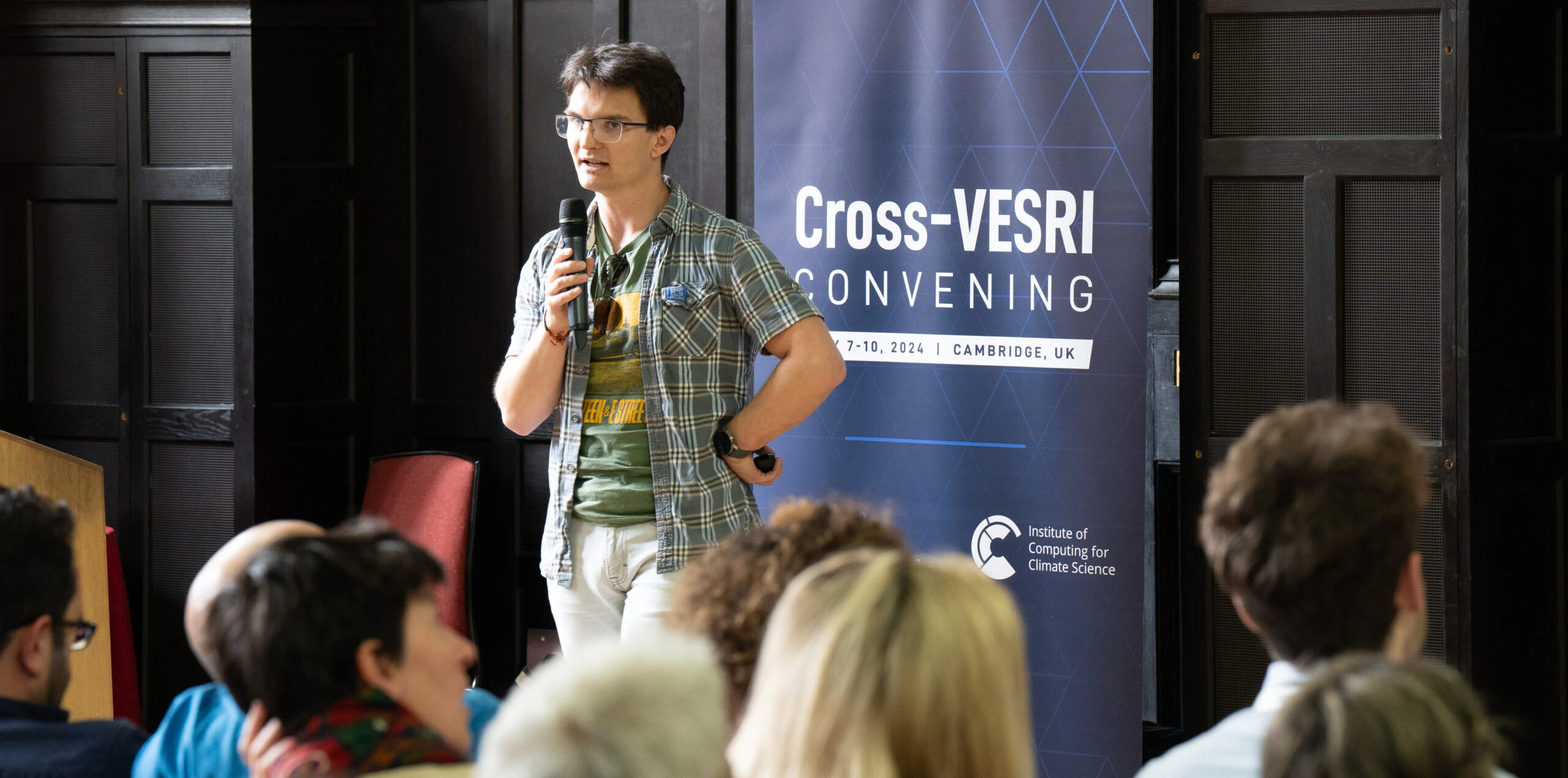
Climate models are our best attempts to rehearse the future: they simulate what happens to the planet for a range of future emissions scenarios. ICCS, meanwhile, works behind the scenes to make those rehearsals possible, writing code that’s sturdier, more trustworthy, and easier to reuse.
When one research team arrived with a familiar headache—how to embed a machine-learning model inside a climate model—Atkinson and his colleagues devised a fix. They eventually noticed the same problem cropping up across other VESRI projects, so they hardened the solution, expanded it, and released it as FTorch, an open-source bridge between the languages that power machine learning and climate modeling. FTorch now appears across multiple VESRI projects, and it has also been adopted by Germany’s national climate computing center, and the National Center for Atmospheric Research’s Community Earth System Model project.
Beyond building tools, ICCS aims to educate researchers on software engineering principles. When Atkinson’s team works on a project, they explain their methods along the way and encourage researchers to adopt practices, such as testing code, that aren’t common in the academic world. The institute also runs an annual summer school and has published open-source training materials in machine learning and research software engineering principles more generally.
Better code means better models—and a better shot at understanding what’s coming. “I really like the feeling of making a difference on these projects, knowing that they’ll be used to do better science,” Atkinson says.
Science Systems
The Journal of Open Source Software | Mar 6, 2025
VISS