
Rachel Mandelbaum, Andy Connolly
| Program | LINCC Frameworks |
| Organization | Carnegie Mellon, University of Washington |
| Field of Study | Astrophysics & Space |
A telescope is only as powerful as the tools scientists have to use its data. LINCC Frameworks is building the open-source software infrastructure the astronomy community needs to turn the Vera C. Rubin Observatory’s unprecedented data into discovery.
When the NSF-DOE Vera C. Rubin Observatory begins its decade-long Legacy Survey of Space and Time (LSST), it will image the entire southern sky repeatedly, cataloging tens of billions of objects and generating a dataset of staggering scope. The telescope is funded. The camera is built. The observatory is ready to release images, catalogs, and alerts to the community. The software that thousands of astronomers need to actually use the data including the analysis pipelines, statistical tools and community frameworks fell to the community to develop – and it did not have the resources to do so.
The LSST Interdisciplinary Network for Collaboration and Computing—or LINCC Frameworks—was built to fill that gap. Funded by Schmidt Sciences and co-led by Dr. Andy Connolly at the University of Washington and Dr. Rachel Mandelbaum at Carnegie Mellon University, the project noticed the pattern years before the telescope saw first light: funded hardware and data releases, ambitious science goals and the community left to figure out the analysis software alone. They rarely did, at least not at the scale required. “It’s really not enough to make your software public and put it on GitHub,” says Mandelbaum. “Someone has to actively maintain it, document it and work with users.”
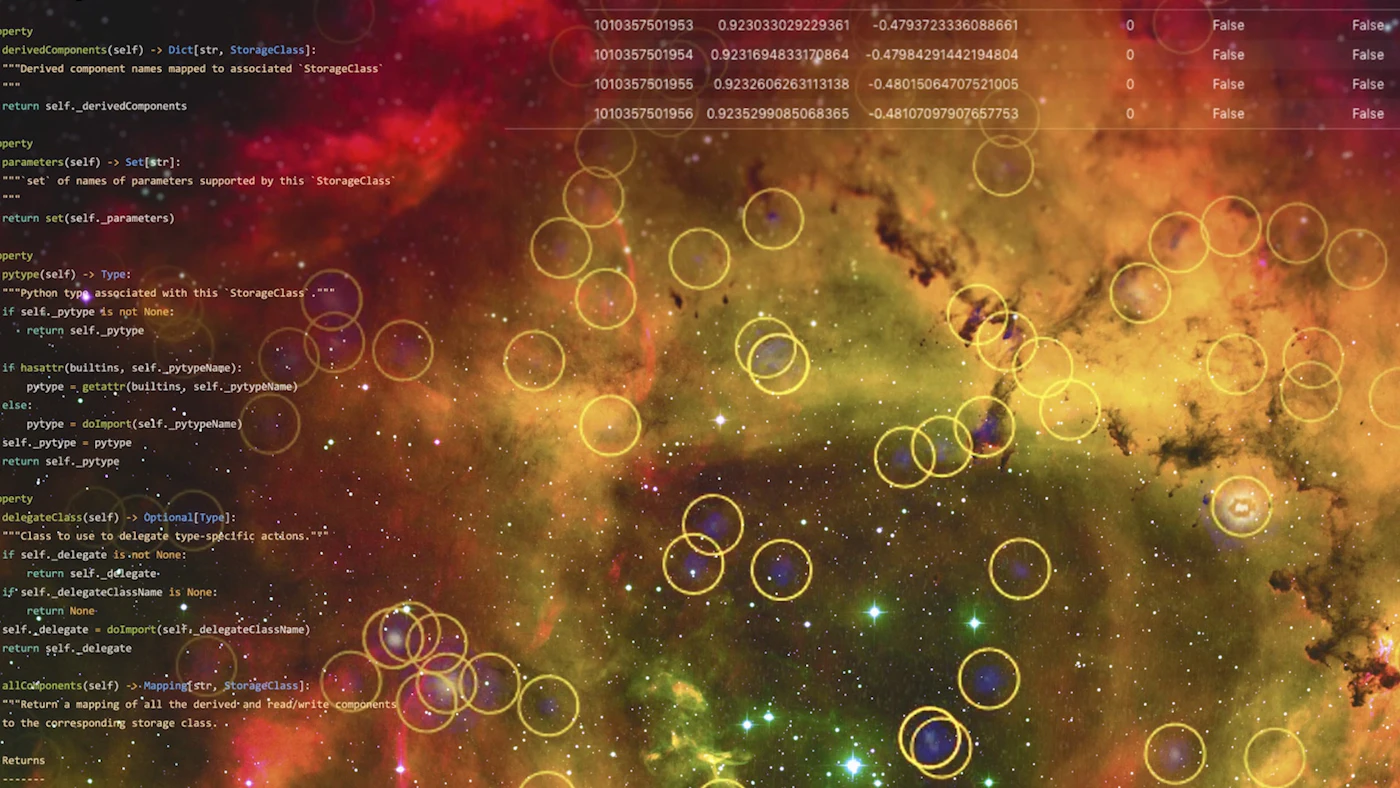
LINCC Frameworks employs a team of research software engineers and research scientists who collaboratively build, maintain and support open-source tools for the LSST community. Their work spans the technical spectrum: catalogs that cross-match billions of objects, statistical frameworks for photometric redshift estimation and simulation pipelines for testing analysis methods before real data arrives. Each tool is designed not for a single research group but for the community at large.
The approach is already demonstrating its value to the astronomical community. Through an Incubator program, LINCC Frameworks engineers collaborate with researchers on specific computational bottlenecks. In one case, the team sped up a solar system simulation by a factor of a hundred, turning a three-week computation into three hours and fundamentally changing how the scientist could use the code. The program has revealed an enormous appetite in the community for this kind of collaborative engineering support—the kind of work that rarely attracts traditional funding but proves essential once it exists. LINCC Frameworks is now preparing for Rubin’s next data preview, building tools at scale and maintaining the agility to pivot when the data inevitably produce surprises no one anticipated.
For Mandelbaum, the work is a natural extension of a career spent building tools others rely on. She previously co-developed GalSim, a galaxy image simulation package that became a standard in the field. “Being able to influence and enable a broad community is incredibly satisfying,” she says. “Much more so than just doing my own science in isolation.”