
Laure Zanna
| Program | Virtual Earth Systems Research Institute (VESRI) |
| Organization | New York University |
| Field of Study | Climate |
Laure Zanna uses AI to make climate models faster, more accurate and more accessible to communities without access to supercomputing resources, ultimately democratizing climate modeling and recruiting a broader scientific community to help meet the challenges of a warming world.
A simple ambition drives climate physicist Dr. Laure Zanna’s program: to transform Earth system modeling through AI. She serves as lead principal investigator for M2LInES(Multiscale Machine Learning In Coupled Earth System Modeling), part of Schmidt Sciences’ Virtual Earth Systems Research Institute (VESRI) program. Her team is revolutionizing what models can do.
When M2LInES was founded in 2021, computing innovation was already reshaping climate modeling. But even with generational advances, models required massive computational resources, took weeks to run and generally couldn’t deliver spatial resolution below 100 km2 grids (around 38.61 square miles). Although models now typically allow smaller-scale exploration, commonly twenty-five km2 grids (around 9.65 square miles), that still falls short of the resolution needed to accurately simulate the interactions of complex systems, which leaves a gap modelers call unresolved scale.
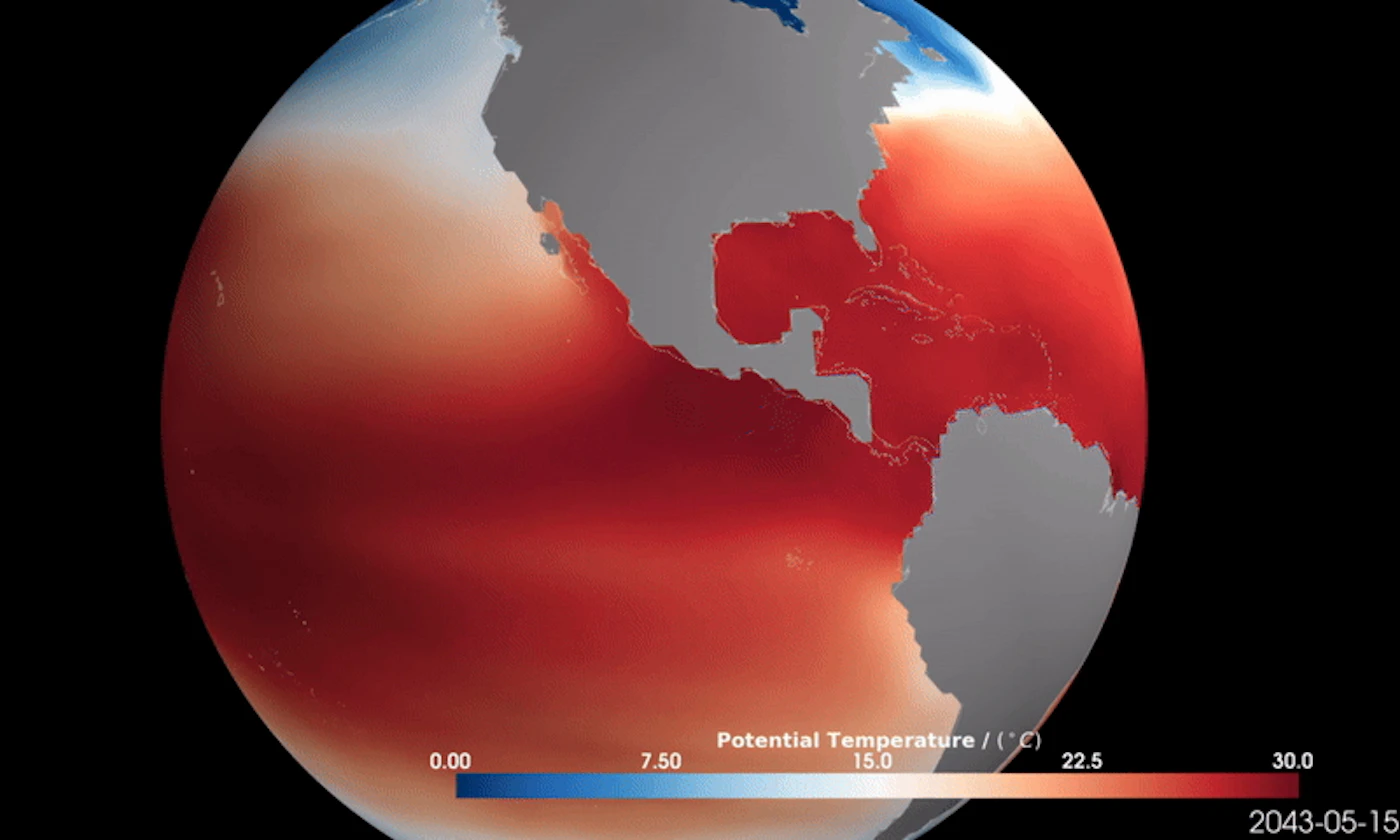
“Basically, unresolved scale means the kinds of processes that are not captured by the current generation of climate models, because we’re limited by computing capacity,” Zanna says. “We are solving equations of motions, but we have to chop them off into pieces to make them fit. And of course, because computing capacity is limited, the minimum size of those grid boxes is 25 kilometers by 25 kilometers. So anything happening underneath that scale is just not resolved by the simulation. In the atmosphere, that would be cloud formation, turbulence, radiation. In the ocean, mixing processes are not represented. That tells you there’s a lot of physics missing.”
Using AI and data generated through machine learning, Zanna’s team is improving representation of those unresolved scales, reducing errors in model outputs’ large-scale flows, ultimately improving climate models’ accuracy. She calls this approach hybrid modeling, physics meets AI.
“We’ve been able to actually learn, from high resolution simulation, the effect of ocean turbulence on temperature. We use those representations—plugging them back into the climate model—to reduce the error in existing simulations. And we have another example for the atmosphere that shows something similar,” Zanna says.
The team’s success led them to a bigger question: Could they fully machine-learn the evolution of a model? They were inspired by recent advances in AI-supported weather forecasting, but climate models tackle exponentially bigger scales. Zanna explains that running a numerical model might require a supercomputer with 5,000 CPU cores, but using machine learning to train a model data, the AI model is then relatively fast and runs on a single GPU.
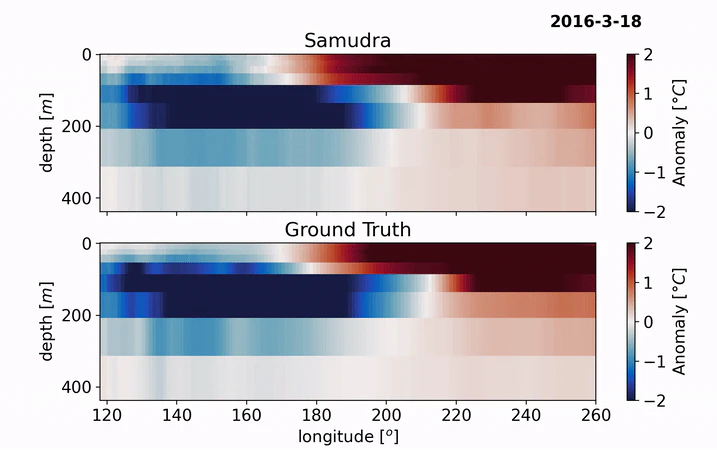
Their first prototype, Sumadra which is an ocean AI Emulator, has been able to learn the solution of a climate model solely from its output. It can run simulations over hundreds of years on one GPU, and it’s about 400 times faster than the model it’s based on. Just weeks ago, the team launched the first full 3D ocean-plus-atmosphere-plus-sea-ice global emulator, SamudrACE. Zanna thinks this one might be 1,000 times faster than its training model.
“These models run so fast that you don’t need to be a climate modeler to run them. They’re open source, they’re online, they’re available to anyone. This is a new way to democratize climate modeling,” Zanna says.
To take on new challenges, Zanna’s team is building partnerships, including one with non-profit software research group Open Athena to work through the problems of multi-scale physics. In particular, Zanna sees potential for the collaboration to unlock their ability “to ingest different sources of data, from both models and observations, to produce a better estimate of what the past ocean was. So we can raise new questions.”