
Andreas Joergensen
| Program | AI in Science Fellowship |
| Organization | Imperial College London |
| Field of Study | Computer Science |
Navigating the dense landscape of AI methods and tools to support science presents a challenge that a group of multidisciplinary researchers, including Andreas Joergensen, found unnecessarily complicated. They combined lessons from their work with AI to offer a roadmap to help scientists make the right choices for their projects.
From unlocking three-dimensional protein structures to sustaining fusion reactions, AI is delivering breakthroughs across scientific disciplines. But researchers are generally left to teach themselves the technology, encountering an array of unfamiliar tools and approaches. Even their labels can be confusing. “AI methods can go by different names in different research communities,” says Joergensen, a senior teaching fellow at Imperial College London for Schmidt Sciences’ AI in Science program. Gaining confidence starts with understanding the language.
“Learning that terminology makes it much easier to navigate the field, and looking beyond your own discipline can be very rewarding. You often find that the exact tool you need has already been developed for another area of science” Joergensen says.
But choosing a suitable AI method is only the first step. Once researchers identify a promising tool, the next challenge lies in testing it. Without understanding how it behaves, researchers may be selecting a tool that doesn’t genuinely support the questions they want to answer.
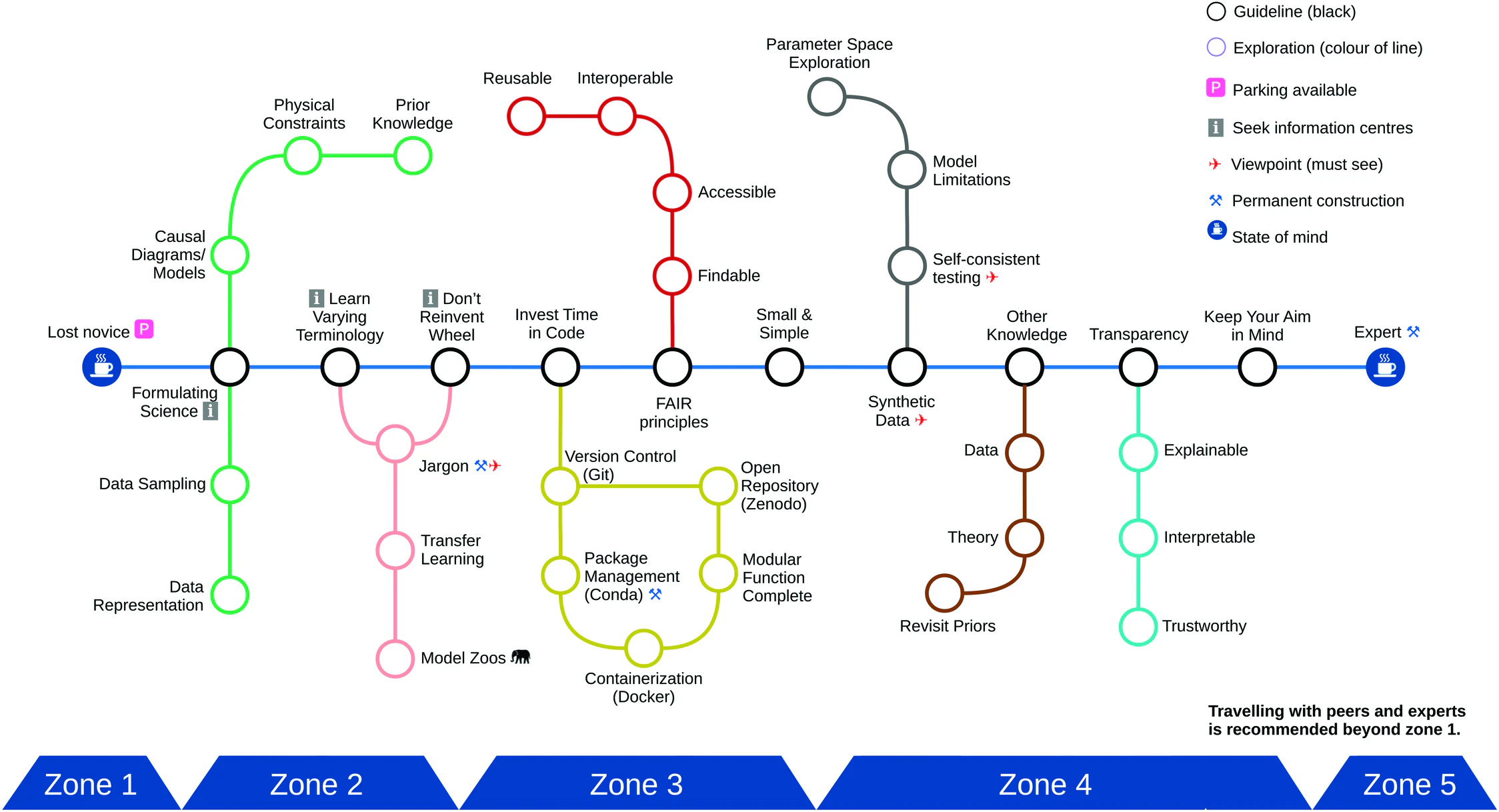
Joergensen and ten Schmidt AI in Science Fellows published, “Ten simple rules for navigating AI in science” in PLOS Computational Biology to help their peers avoid setbacks like this. The paper provides early-career researchers with practical guidance on choosing methods, understanding the broader landscape, and working with AI tools in a reproducible and rigorous way. The rules reflect insights gained through the authors’ own learning and practice, and many of the challenges they encountered were similar across diverse disciplines.
“Ten simple rules” defines AI tools broadly, encompassing everything from statistical methods to sophisticated deep learning algorithms. The paper outlines tactics to start searches, evaluating simpler solutions and investigating existing options before building from scratch. It also covers testing approaches, including using synthetic datasets to determine whether an issue comes from the model itself or from real-world data. The paper stresses building an understanding of how models reach their conclusions, and how others might reproduce results.
Joegensen emphasizes an overarching safeguard: Keep perspective. “It’s easy to become overly focused on optimizing AI models. The technology’s potential is real, but researchers must remember their goal of explaining what’s happening in the real world,” he says. “In the end, it’s about the science.”