
Argus Array
| Program | The Eric and Wendy Schmidt Observatory System |
| Organization | University of North Carolina, Chapel Hill |
| Field of Study | Astrophysics & Space |
The fastest events in the universe have been difficult for astronomy to catch—until now. Dr. Nicholas Law and the Argus Array will watch the entire visible sky every second, opening a new regime of discovery at timescales no existing telescope can reach.
The conventional way to survey the sky for changing objects is to look at one small patch, then the next, then the next, cycling through the whole sky over days or weeks before checking back to see if anything has changed. This approach has yielded tens of thousands of supernovae and reshaped our understanding of the universe. But it has a fundamental blind spot: anything that happens fast, on timescales of seconds or minutes rather than days, is effectively invisible.
The Argus Array, led by Principal Investigator Dr. Nicholas Law at the University of North Carolina, Chapel Hill and cofunded by XTX Markets founder Alex Gerko, aims to eliminate that blind spot. More than 1,000 telescopes unite into an array that will cover the entire Northern sky in every single exposure. Where existing surveys revisit each patch of sky every day or every few days, Argus operates at cadences down to one second—compared to traditional sky surveys that’s a 100,000-fold improvement in temporal resolution, or the precision of a measurement with respect to time. That leap opens an entirely new regime of astronomical science.
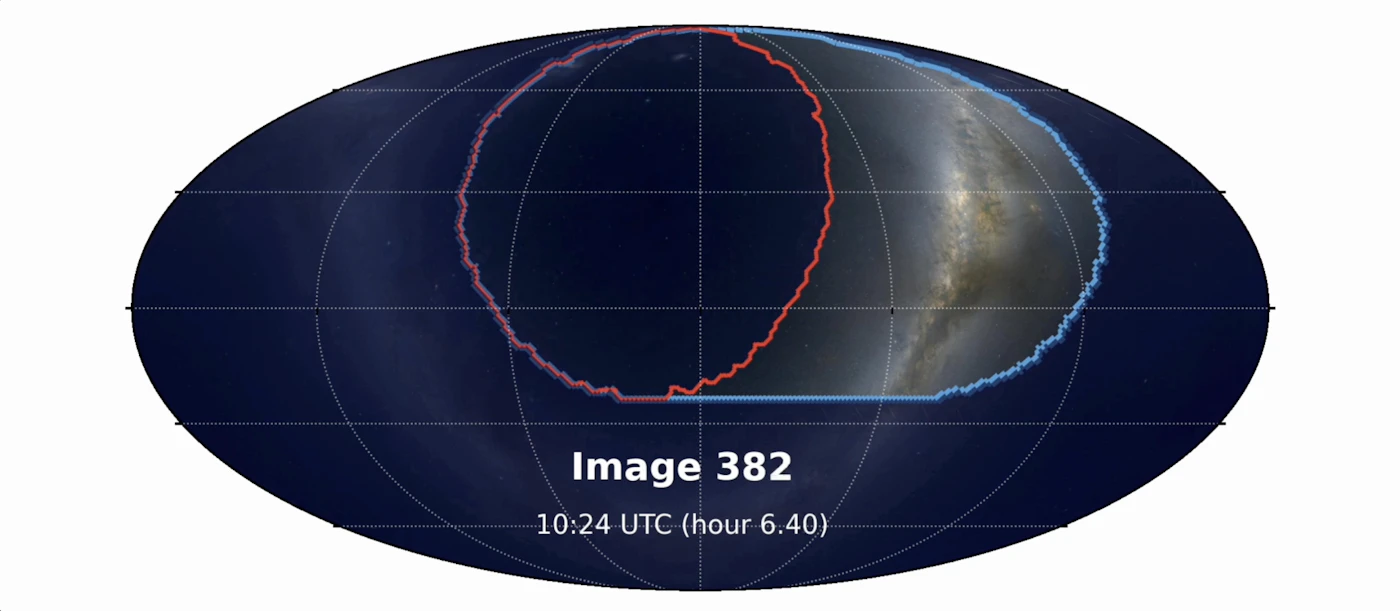
The system will be the largest imager ever assembled: 120 gigapixels covering 8,000 square degrees, generating data at terabit-per-second rates. The machine learning challenge alone is immense. When Law started in transient astronomy, teams of graduate students reviewed each detection by eye every morning. “If we tried to do that with Argus at the data rates we’re seeing,” he says, “we would need thousands, maybe tens of thousands of graduate students. And they would all be extremely bored.” Instead, the system streams data through powerful computing clusters to classify and issue alerts within seconds.
But Law is driven less by the things Argus will predictably find, and more by those it cannot. “It’s not the things that we can predict that really drive me on this,” he says. “I want to see the unknown unknowns.” With thirty institutions contributing to the science concept team, the planned observations span everything from stellar explosions to interstellar objects entering the solar system. The real win is in events and phenomena that current telescopes simply cannot detect because they happen too fast, too faintly or too briefly. To find them, the team must first characterize everything known that the sky contains, then search for whatever doesn’t fit.
Open science is built into the project from inception, with the Schmidt Sciences grantors asking that all data be released publicly, a requirement Law calls “wonderful” and “actually somewhat rare in astronomical projects of this size.” The dataset will serve professional astronomers, but also amateur observers, educators and students—in effect, a continuously updated movie of the sky, available to anyone.
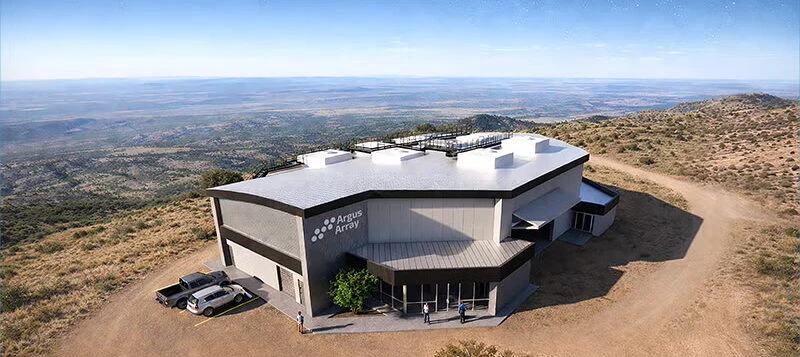
Construction is now underway, with the first components slated to be completed in late 2026. Argus is part of the Eric and Wendy Schmidt Observatory System, an astronomical ecosystem that represents a new approach to building scientific infrastructure — faster, more adaptive, and designed to work as a connected system rather than in isolation. But for now, the immediate goal is ambitious enough: a real-time movie of the night sky, watched by a thousand eyes that never blink, searching for whatever the universe decides to show them.