Leoncio Santiago-Martinez
| Program | Virtual Institute for Feedstocks of the Future (VIFF) |
| Organization | University of Wisconsin Madison |
| Field of Study | Biosciences |
Leoncio Santiago-Martinez and CMORE are investigating chemical processes to remove inorganic materials from common sources of waste—like agricultural and food byproducts—unlocking their potential for reuse in a circular economy
Growing up on his parents’ small sugarcane farm in Central Mexico, Leoncio Santiago-Martinez saw firsthand the potential of agricultural byproducts.
“It’s a small Indigenous community, rich in biodiversity, but in need of more development,” says Santiago-Martinez, a research associate at the University of Wisconsin Madison. “If we want to develop a community, we need to develop processes to take advantage of these bioresources.”
Santiago-Martinez became one of the very few people from his town to enter college to study chemical engineering and to explore how to convert agricultural waste into fuel and other materials. “At the beginning, I thought it would somehow be easy,” Santiago-Martinez says. “It has been amazing to see how complex the field is, how complex biomass is.”
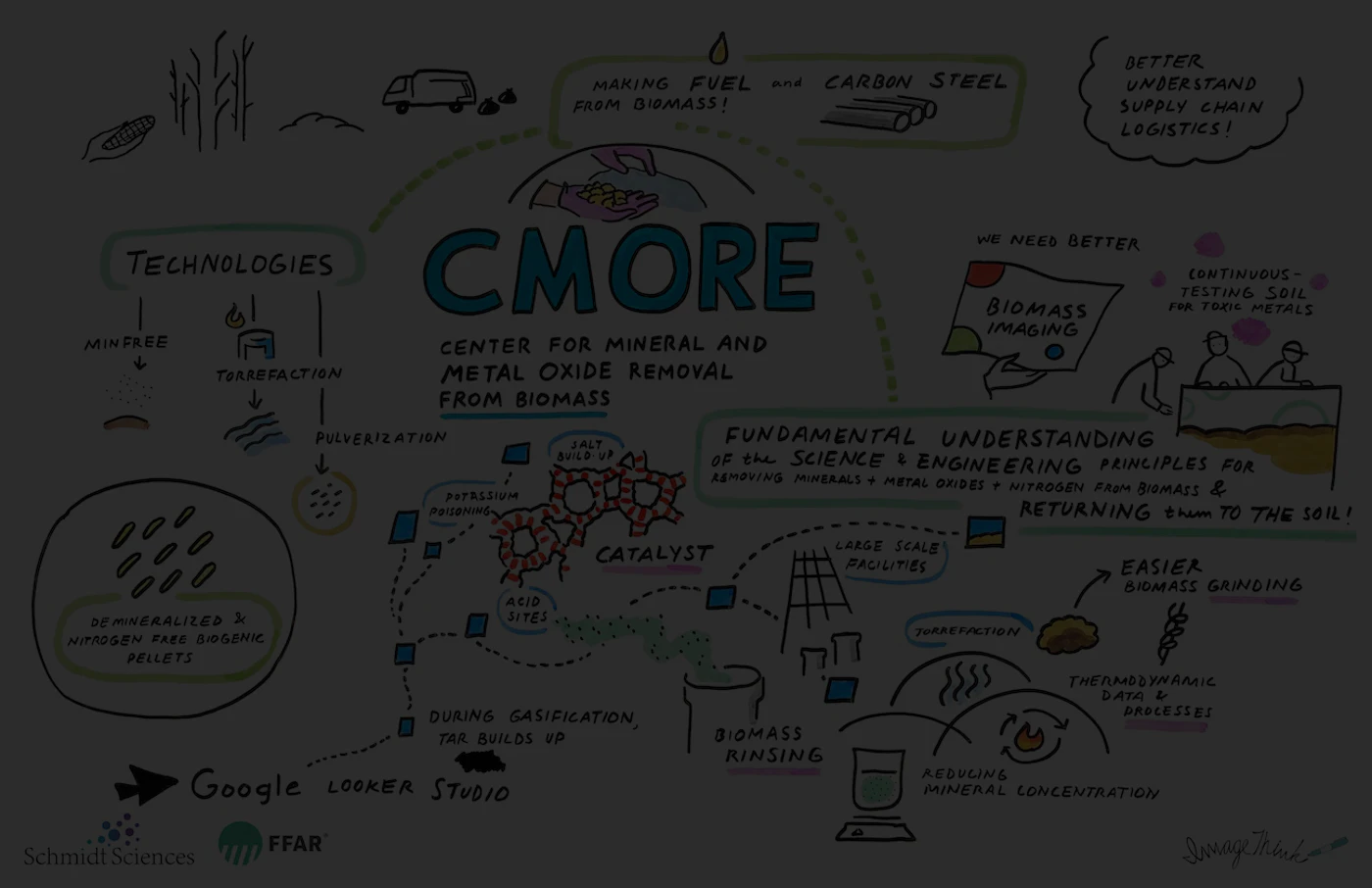
As project manager of the Center for Mineral and Oxide Removal from Biomass (CMORE), supported by Schmidt Sciences’ Virtual Institute on Feedstocks of the Future, Santiago-Martinez is tackling that complexity head on. The project will test ways to remove inorganic materials from sources including agricultural and food processing byproducts, forest residue from diseased trees and municipal solid waste.
“Half of the municipal solid waste are organic and food residues, and that’s something we can use,” he says.
Santiago-Martinez and his colleagues will explore acid washing as a way to remove inorganics—minerals and oxides—using common products like acetic, sulfuric and hydrochloric acid, familiar from common consumer products like vinegar, batteries and cleaners. Plants pull these elements, including sulfates, nitrates, chlorides and more, from soil to help them grow. Those materials remain in the biomass, whether it’s harvested or waste material. But inorganic compounds, if left in biomass, can hamper downstream processing by corroding equipment or inhibiting certain chemical reactions.
“The general idea is to generate cleaner biomass for any use,” Santiago-Martinez says. Byproducts could be converted into everything from jet fuel to foam.
To date, the CMORE project has discovered that there is more to discover.
“Biomass is much more complex than typically described in the literature,” he says. “We think of biomasses as having three main components, but in fact, there are many, and they are bonded with the biomass in a variety of ways. We don’t have a clear idea how much or what mineral content is in biomass.”
Santiago-Martinez is in it for the long haul—from his current work of developing technologies, to future efforts to scale and finally to bring it to communities worldwide like his hometown.
“We need to work directly with people to show how these technologies can benefit them,” Santiago-Martinez says. “It may take 10 years or more, but I hope to contribute to that effort, and not only in Mexico.”