
Matt O'Dowd
| Program | Future Lens |
| Organization | City University of New York |
| Field of Study | Astrophysics & Space |
The Future Lens collaboration is building the machine learning infrastructure to decode the tangled signals from gravitationally lensed quasars, unlocking new measurements of dark matter, black holes and the expansion of the universe. All while the Vera C. Rubin Observatory begins generating data at unprecedented scale.
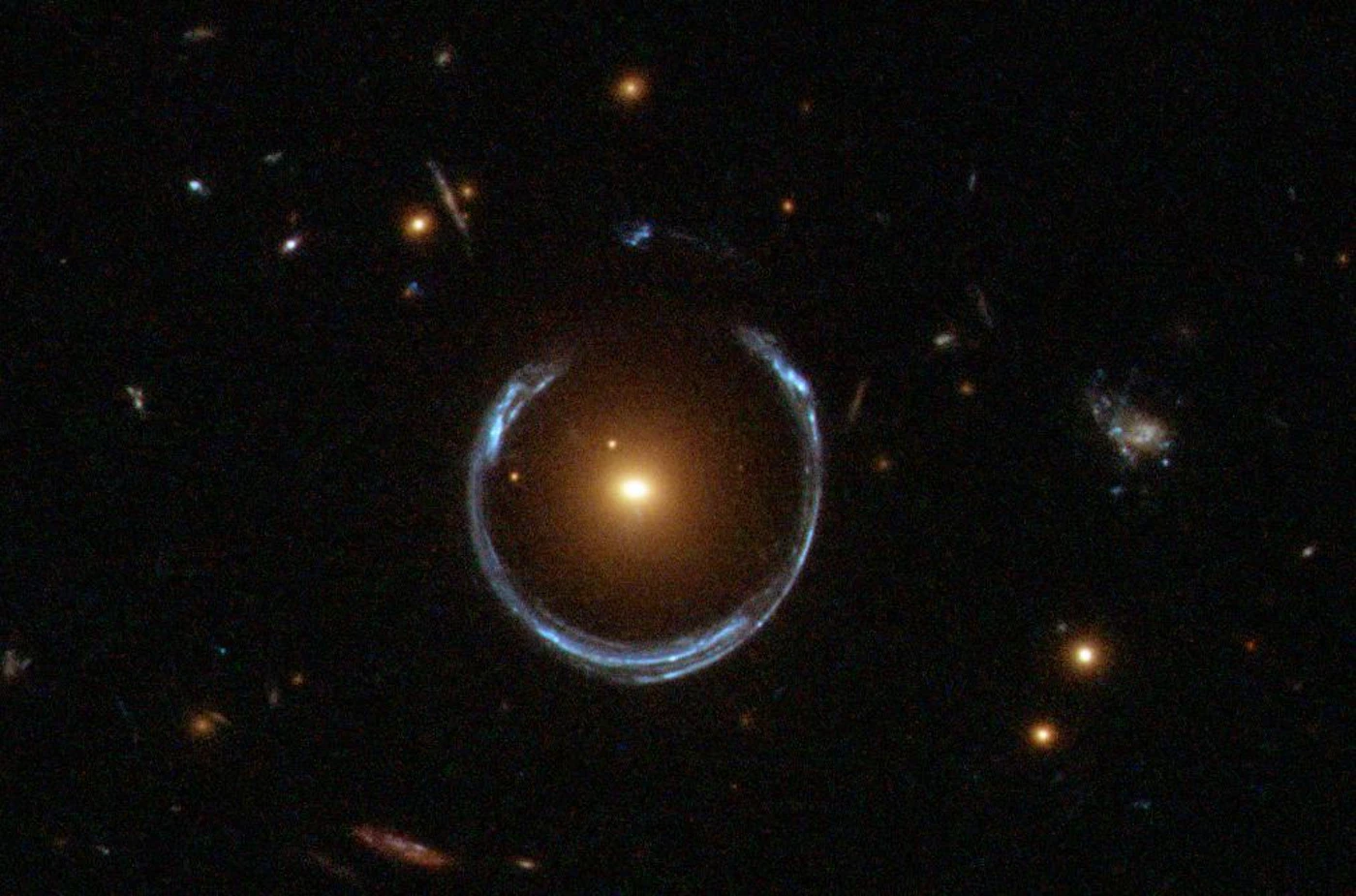
Somewhere in the distant universe, a supermassive black hole feeds on surrounding gas, blazing with enough energy to outshine its entire host galaxy. Between that quasar and Earth, a massive galaxy bends spacetime; a gravitational lens that splits the quasar’s light into multiple images.Those images flicker with the wild fluctuations of the quasar and in the shifting gravity of the lensing galaxy, whose stars are in constant motion. It seems chaotic, but imprinted in that flickering is information about the distant black hole, the galaxy’s dark matter, and even the expansion history of the universe.
The information is extraordinary. The problem is extracting it. From observational noise to quasar variability, gravitational lensing tangles multiple physical signals together. For decades, astronomers studied these systems one at a time, painstakingly modeling each lens by hand. The Vera C. Rubin Observatory is about to change the scale of the problem entirely. When its ten-year Legacy Survey of Space and Time (LSST) begins, it will generate a flood of data that no manual approach can handle.
Dr. Matt O’Dowd, an astrophysicist at the City University of New York and the American Museum of Natural History, leads the Future Lens collaboration, a Schmidt Sciences-funded effort to build the machine learning infrastructure needed to decode these signals at scale. The team develops neural networks trained on sophisticated simulations that can disentangle the overlapping effects in lensed quasar light curves, extracting measurements that would take traditional methods orders of magnitude longer. “It was pretty nerve-wracking to start,” O’Dowd admits. “There was this sense of vertigo stepping into this. Can we even do it?”
They can. The collaboration produces tools for measuring these rare astronomical phenomena—work that would take traditional methods orders of magnitude longer. At the heart of the approach is simulation-based inference, where neural networks learn to connect physical parameters to observable data by training on millions of simulated light curves. It’s a fundamentally different way of extracting meaning from messy signals, and it’s already being validated on real data.
Schmidt Sciences funding enabled the team to hire researchers and build computational infrastructure at a scale that traditional grants rarely support for methodological work. The collaboration spans multiple institutions, and the tools it produces are designed to be used by the broader astronomical community, not locked within a single research group.
O’Dowd traces his path to this work through an unlikely trajectory. Growing up in a working-class suburb of Melbourne, Australia, with no family history of higher education, he pursued physics because it seemed to hold answers to the deepest questions he could imagine. Gravitational lensing captivated him because of its promise as a puzzle. “The information is there,” he says. “You just have to figure out ways to pull it out.”
The team itself has been a source of reward. “All of the brilliant work has been done by students and postdocs,” O’Dowd says. “My job has been nudging in different directions along the way and offering what I can.” Watching new graduate students throw themselves into these problems and emerge as world experts over the course of their training has given O’Dowd and the project a sense of purpose beyond the science alone.