
Kaveri Iychettira
| Program | Research Frontier Network |
| Organization | IIT Delhi |
| Field of Study | Climate |
Dr. Kaveri Iychettira is mapping India’s energy future, development pathways and the socioeconomic impacts of balancing rapid growth and national decarbonization ambitions to help the country chart a course toward a greener, safer and fairer future for all.
The risks elevated by a changing climate, the opportunities created by a growing economy and the effects of pollution emitted as a byproduct of that growth are distributed unequally everywhere. In countries like India, though, rapid development intensifies the impacts of those inequalities, exposing millions to mounting threats that more fortunate communities can afford to defend against. Dr. Kaveri Iychettira and the research hub at Indian Institute of Technology Delhi’s School of Public Policy explores paths to simultaneously improve lives across India while slashing carbon emissions and accelerating economic expansion.
“We’re trying to figure out how to achieve developmental aspirations while mitigating emissions, something that no country has figured out yet,” Iychettira says.
Finding that balance can make a difference in countless lives. While roughly 15% of India’s population lives within the government’s multidimensional assessment of poverty—a significant improvement in recent decades—Iychettira estimates that as many as 30% live adjacent to poverty, precariously close to devastating financial setbacks from health or climate or economic shocks. Charting the right course for India’s future can insulate vulnerable segments from the worst effects of environmental pollution, severe weather, and a shifting economy and energy landscape. It begins with an unprecedented mapping mission.
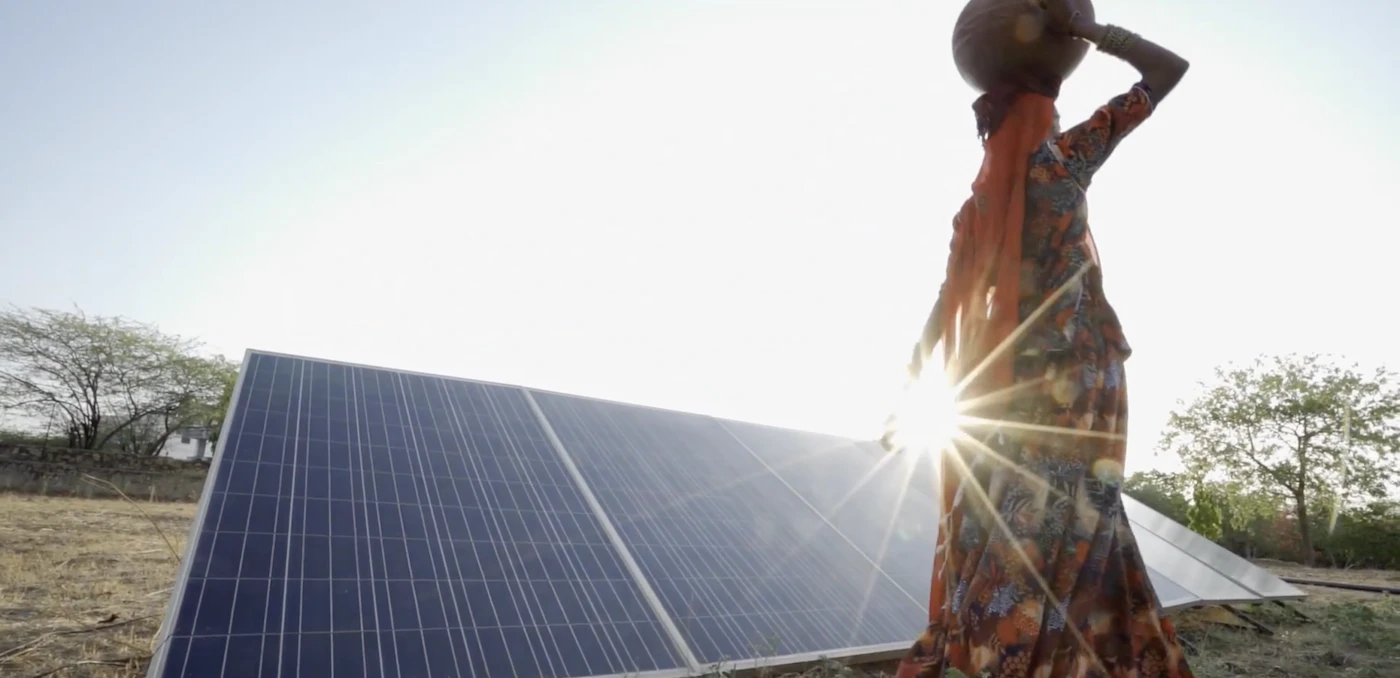
“This will be the first project that makes spatially resolved projections of the energy transition in India,” Iychettira says. “We will produce very detailed maps—grid cell sizes of 2 square kilometers—where we locate different energy power plants and so on. That will give us the first estimate of what the trade-offs really are, the land that we need, how much of it overlaps with tribal areas, agricultural land, and wasteland or commons—which may not be owned by private individuals, but may still be heavily used by livestock owners and grazers. There’s really no land that is unused in India.”
That precise level of assessment allows deep exploration of synergies and tradeoffs between mitigation pathways and developmental outcomes. Iychettira explains, “For example, if carbon capture, utilization and storage does not become as feasible as we hope, or hydrogen costs don’t fall as quickly as we’d like, then what does that imply for the amount of land we need for renewables, employment opportunities or pollution?”
The project is already helping Iychettira’s team answer those questions. “Just being able to spatially resolve our model outputs and energy system projections, and then overlaying them with socioeconomic data or agricultural maps—data from very different domains—already gives us interesting insights. It’s never been done before,” she says.
The team plans to augment mapping and modeling insights with in-depth case studies on how particular communities are affected by India’s transformation. Interviews with diverse experts, from climate scientists to specialists who work with farmers, and detailed survey campaigns will also help the team build a holistic picture of what potential trade-offs mean at local levels.
For Iychettira, the project’s ambition stems partly from personal inspiration. “I have a two-year-old daughter,” she says. “One of my biggest worries is that she will not be able to breathe clean air when she goes to school, and that can affect her lungs, potentially for the rest of her life. If projects like these make even a tiny bit of difference to improve those outcomes, not just for my daughter but for millions of people here, that would be amazing.”