
Shirley Ho
| Program | AI2050 |
| Organization | New York University |
| Field of Study | Artificial Intelligence |
By building foundation models trained on large-scale scientific datasets, Shirley Ho shows how AI can serve as shared infrastructure for science and help researchers move from raw data to insight in seconds rather than months.
To date, the promise of artificial intelligence in science has mostly been framed in terms of language: models that can read papers, summarize findings and suggest new hypotheses. Dr. Shirley Ho, a Schmidt Sciences AI2050 Fellow, sees the problem differently. Science, she argues, does not ultimately run on prose, it runs on measurements. Telescopes record light curves, satellites capture images, simulations generate time series. If AI is going to meaningfully accelerate discovery, it must learn from the data scientists actually work with, and not just the papers they publish.
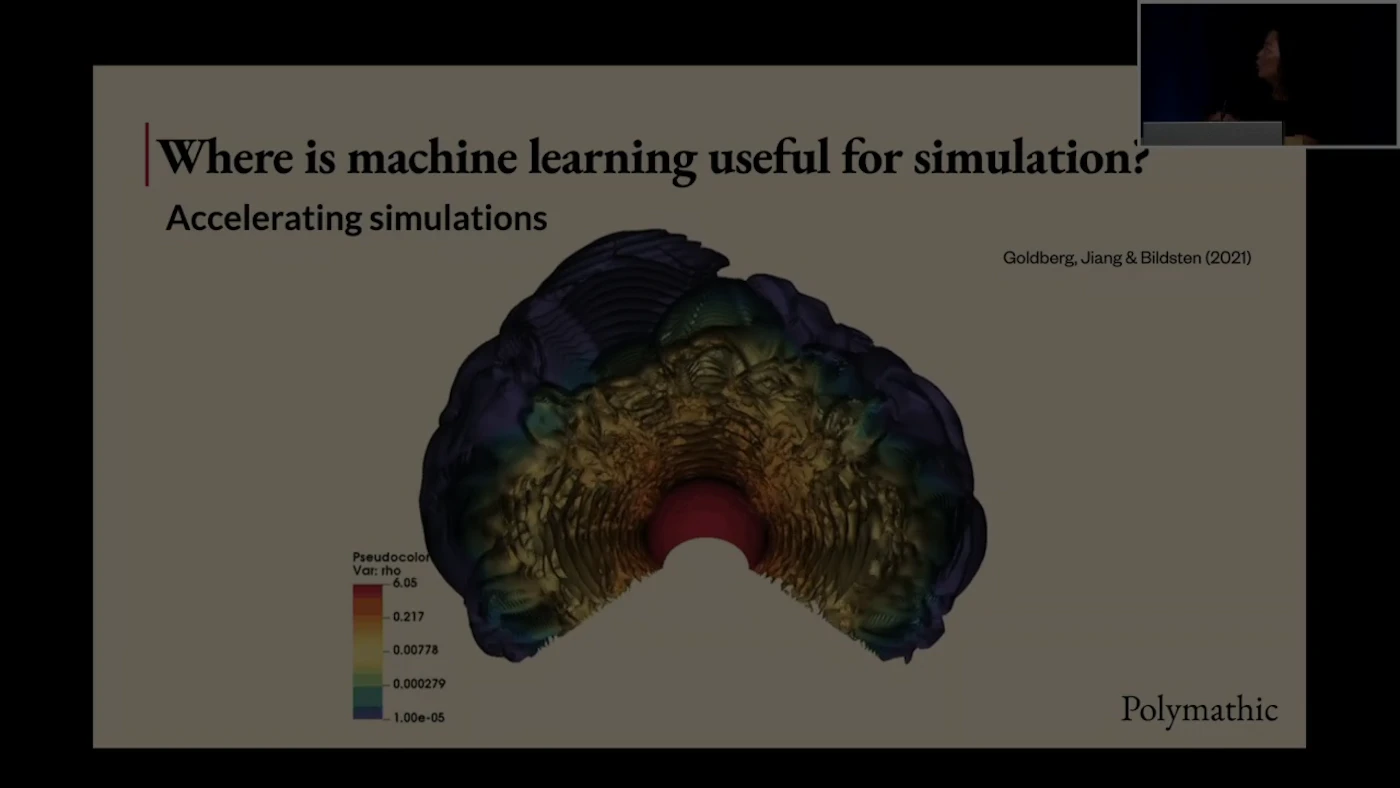
Ho, co-founder of Polymathic AI, is building what she calls a “multidisciplinary AI for science”––a system trained directly on large, structured scientific datasets across domains. Rather than fine-tuning AI models for one field at a time, her team aims to capture shared patterns that underlie physics, astronomy and beyond. Through initiatives like The Well, a curated collection of physics simulations, and models such as Walrus, Polymathic AI trains foundation models to learn the dynamics of complex systems from raw data. The ultimate goal of these tools is to create a scientific generalist capable of transferring insight from one domain to another.
The practical payoff lies in speed and accessibility. Ho describes models that can compress million-hour simulations into results delivered in seconds, enabling researchers to explore design spaces that were previously out of reach.