
Edem Mahu
| Program | Ocean Biogeochemical Virtual Institute (OBVI) |
| Organization | University of Ghana |
| Field of Study | Climate |
To climate scientists, the Gulf of Guinea appears to have every attribute of an extraordinary carbon sink, but virtually no research support is dedicated to exploring the dynamics that make it one of the most nutrient-rich regions of the Atlantic. Edem Mahu and the Ocean Margins Initiative are closing that gap.
Off West Africa’s coast in the Gulf of Guinea, cold, nutrient-rich water rises from the deep Atlantic to displace the warm layer above. This upwelling fuels phytoplankton blooms that sustain essential fisheries and pull carbon dioxide from the atmosphere.
Yet scientists know surprisingly little about how carbon and nutrients cycle through these waters. It’s not an isolated oversight: Global climate models don’t account for these processes at this and other tropical ocean margins.
Edem Mahu, an Associate Professor of marine biogeochemistry, and two colleagues established the Ocean Margins Initiative (OMI) at the University of Ghana to conduct a comprehensive study of these dynamics in the Gulf and their implications for global climate.
“This is one of the places where we expect a huge uptake of carbon,” Mahu says. “But unfortunately, it has not been studied at all.”

With support from Schmidt Sciences’ Ocean Biogeochemistry Virtual Institute (OBVI), OMI is investigating what drives the upwelling—and how it shapes fisheries that feed millions of people. As a marine biogeochemist, Mahu’s focus is on the nutrient cycle. She wants to know where the nutrients come from, what happens to them, and how much is converted into forms that organisms can use.
The work has global implications. The observational tools and modeling approaches the team is developing will be relevant to coastal regions worldwide. And their findings will help researchers better understand how tropical upwelling fits into global carbon cycling—insight that could ultimately improve climate models. There are more immediate stakes, too. Better data could improve the management of fisheries here and elsewhere.
In traditional international research collaborations, funding flows through institutions in the Global North. Mahu has experienced the constraints imposed by this approach. “It is difficult to buy equipment or undertake capacity building in the Global South,” she says.
Schmidt Sciences’ support works differently. The funding came as a flexible gift, and from the start, the team agreed that whatever capacity they built in Ghana would stay in Ghana.
In roughly a year and a half, Mahu’s group has established a modestly sized new lab at the University of Ghana. They have partnered with the Ghana Navy for subsidized ship time and are installing a meteorological tower that provides weather and air quality data for their research and local agencies. “We have achieved so much in a very short amount of time,” she says.
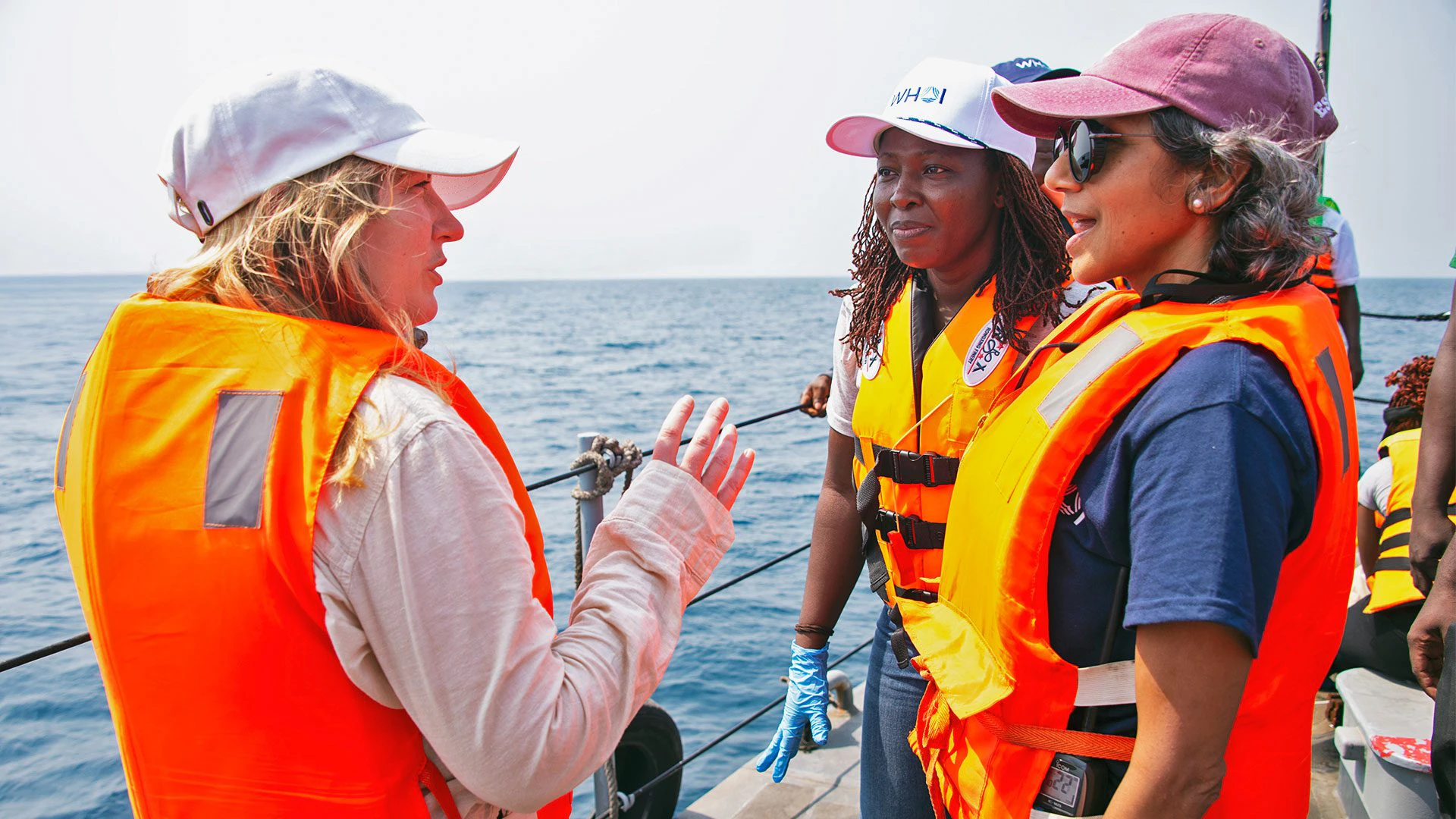
The project has also begun training the next generation of scientists. OMI currently has a handful of master’s students, four PhD students and two postdocs, with more positions in the works. And for the next four years, OMI is funding Ghana and Nigeria’s Coastal Ocean Environment Summer School, a program that flips the usual model. Rather than sending a handful of students abroad, it brings researchers from the North to partner with their colleagues in the South to instruct and collaborate with more than 100 Africans each year.
From the start, OMI researchers sought to engage the fishermen who make their living on the water. One of Mahu’s collaborators is now developing tracking beacons for their fishing canoes, and the team has worked with the fishermen to build new moorings for the boats.
For Mahu, OMI represents something larger than a single research project. “This project is giving us the opportunity to ask the broad scientific questions that are being discussed globally,” she says.