
Oded Rechavi
| Program | Schmidt Science Polymaths |
| Organization | Tel Aviv University |
| Field of Study | Neurobiology |
Thanks to an unexpected diversion in a memory experiment, Dr. Oded Rechavi’s lab made a discovery with the potential to advance research on lithium’s mechanism of action and Alzheimer’s Disease.
For years, Dr. Oded Rechavi, a professor of neurobiology at Tel Aviv University, wanted to freeze tiny roundworms at minus 80 degrees Celsius, thaw them and see if they remembered something they’d learned before. The experiment would test whether memory requires constant brain activity to persist. But it was a tricky setup, and for a long time, no one in his lab would attempt it. Then graduate student Dana Landschaft Berliner took it on—but she didn’t follow the plan. Instead of freezing the worms, she exposed them to less severe cold by chilling them on ice.
“She ignored me, did a different experiment, and that led to this discovery,” Rechavi says.
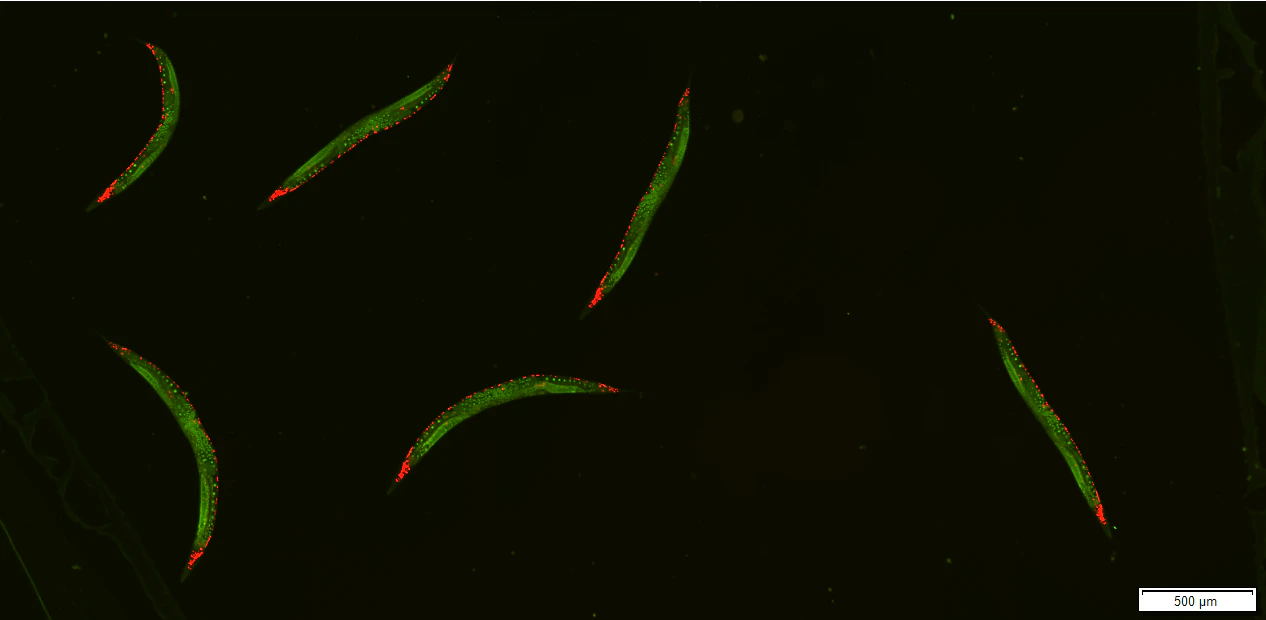
Berliner found that chilling delayed forgetting, but not simply because cold slows biological processes. It also stiffened the cell membranes at the junctions between neurons, a change triggered by what researchers call a “forgetting switch” within the worms themselves.

The path to this discovery was unconventional, but that’s familiar territory for Rechavi, a Schmidt Sciences Polymath. With his creative, curiosity-driven approach to science, he embodies the ethos of the Polymaths program, which supports mid-career researchers as they explore new territory.
Prior to the ice experiments, Rechavi’s lab was already studying memory but in a less conventional form. Working with worms, his team has shown that stress triggers the production of small RNA molecules that can be passed down to subsequent generations, altering the biology of descendants. This discovery helped overturn biologists’ long-standing belief that inheritance flows strictly through DNA.
The freezing experiment grew from the same strategy of challenging dogma. Neuroscientists have assumed that memories depend on continuous electrical activity in the brain. Shutting down that activity by freezing the worms would test if that is indeed the case.
“The idea is always to take something that everyone believes in and try to find that it’s not true, or that there are exceptions,” Rechavi says.
Berliner’s ice experiments led the team to a molecular switch that controls how long memories last. The molecule that operates it, diacylglycerol, makes cell membranes more fluid. Cold reduces its levels, stiffening cell membranes and changing how neurons communicate. Lithium, long used as a psychiatric drug, also suppresses diacylglycerol production and delays forgetting. That connection may explain recent findings linking lithium deficiency and Alzheimer’s disease, a major feature of which is memory loss.
Rechavi’s lab is continuing to study the “forgetting switch”, and in doing so, broaching one of biology’s major questions. “We are our memories,” Rechavi says. “But it’s unclear how they are encoded in the brain. I think it’s one of the biggest mysteries there is.”