
Mansi Kasliwal
| Program | Cryoscope |
| Organization | Caltech |
| Field of Study | Astrophysics & Space |
From Antarctica’s Dome C, Dr. Mansi Kasliwal’s Cryoscope is opening an entirely new observational window on the universe, using innovations in optics, cryogenics and detector technology to capture infrared signals that no ground-based telescope has been able to see.
When two neutron stars collide, the explosion forges some of the heaviest elements in the periodic table. For a brief window, the aftermath blazes in infrared light. And that is precisely the problem. From observatories in temperate latitudes, the night sky is so saturated with thermal infrared radiation that hunting for a kilonova afterglow is, as Dr. Mansi Kasliwal puts it, “like searching for a firefly under a lamppost.”
Gravitational-wave detectors have confirmed that these mergers happen. Astronomers have looked for the accompanying light and came up empty, not for lack of effort, but because the physics conspires against them. The heavy elements produced in these collisions scatter visible photons so thoroughly that the only signal escaping is deep in the infrared, exactly where Earth’s atmosphere and every piece of warm equipment glow like floodlights.
Kasliwal, an astronomer at Caltech and director of Palomar Observatory, is changing the equation by going where the sky is dark: Antarctica’s Dome C, where winter temperatures drop below minus 60 degrees Celsius and the infrared background nearly vanishes. But solving one problem creates another. In that environment, the telescope itself becomes the hottest object in its own field of view. Her team designs the instrument around two innovations. The first is a double-meniscus optical design—the first meaningful improvement on classic telescope architecture in nearly 80 years—delivering a wide field of view in a form factor compact enough to cool inside a vacuum cryostat. The second is a new class of infrared detector, five times cheaper per pixel than existing technology, which breaks the cost barrier that has kept wide-field infrared astronomy out of reach.
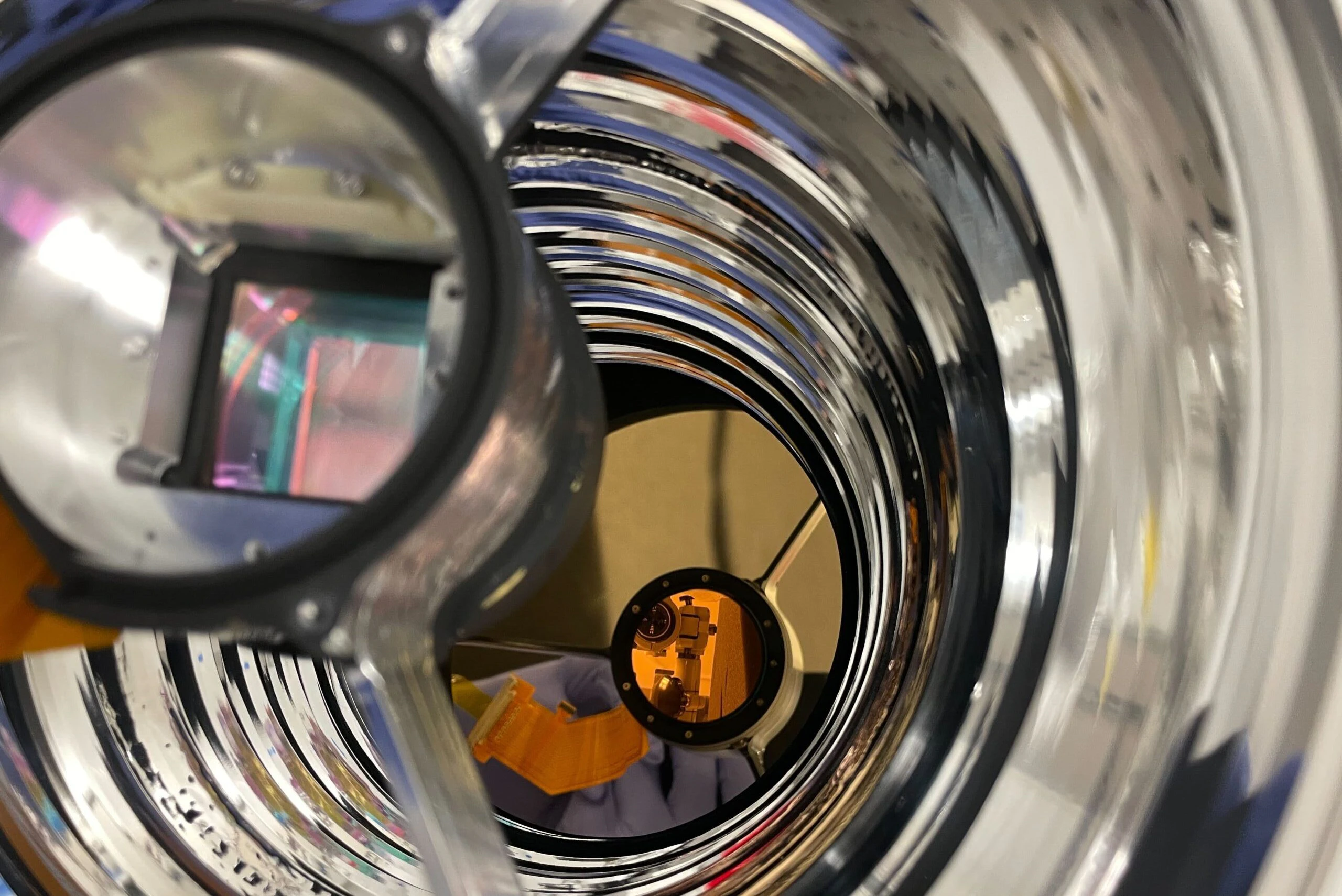
With support from Schmidt Sciences and other partners, the pathfinder campaign is due to deploy to Antarctica in late 2026. There, it will validate the optical design and prepare the team for future steps. But the science case extends well beyond neutron star mergers: the telescope will hunt for transiting exoplanets around red dwarf stars, track infrared signatures of supernovae, and survey asteroid compositions that can only be distinguished at these wavelengths. “We have no data on what the universe does at those wavelengths,” Kasliwal says. “There is no background literature.” The entire dataset will be openly available to all.
For Kasliwal, the deeper motivation is personal. “Astronomy just gives people perspective,” she says. The elements in our bones and blood were forged in exactly the kind of cataclysmic events Cryoscope is designed to catch. If it works, it will prove that some of the universe’s most violent moments have been hiding in plain sight, only visible from the coldest place on Earth, and could bring us closer to understanding our own origins.
Astrophysics & Space
SPIE | Jul 18, 2024
Cryoscope